


Showing posts with label Roberts. Show all posts
Showing posts with label Roberts. Show all posts
Saturday, June 21, 2008
Internet Writing - my comment
Posted by Simon Halliday | Saturday, June 21, 2008 | Category:
Blogging,
Cowen,
Roberts
|
1 comments
I just read the article How is the Internet Changing Literary Style? (hat tip Marginal Revolution)  I think that the author has some decent comments, but fails to address the question of the differences in the kind of writing and the incidence of the reading of such writing. For example, I enjoy reading the long magazine articles from the New Yorker magazine (caught out), or from various other decent publications. However, doing this means that I focus my attention on one subject for a fairly long period of time, normally on a subject in which I am quite interested.
 Blogging, on the other hand, allows me to dip in and out of subjects along a continuum from very familiar to unfamiliar and just get a taste of what they are about, if I read a long magazine article I don't get a taste, I get a 5 course Italian meal. As I am mainly interest in content and grab-factor when getting these tastes, I am not, personally, as concerned as I customarily am with stylistic indicators. I am, and I think always will be, concerned with basic grammar, I don't mean that I want someone to have grammar that is optimal every time I read their blog, or to have flawless spelling, but if you regularly have poor spelling and poor grammar then I am less likely to read your blog. I don't read blogs that use text-speak. The piece mentions the difference in kind, but without as much strength as I would like.


One of the major difference I have also found with blog reading versus normal magazine reading or article reading is the use of hypertext links. Tyler Cowen (right) and Russ Roberts (left) discuss this phenomenon in one of Roberts's PodCasts at EconTalk, they discussed how links have already begun to affect, and will continue to affect how research is done. They don't officially predict the 'end' of the journal article, but they comment on how a prediction was made (and I have trawled those darn podcasts and can't find it) saying that this was the future of Economics as a discipline, and possible of most sciences. I have begun using links in some of my academic note-writing (which LaTex, which is 'FREE', is good for), but I haven't done it at all with actual academic articles. Personally I think that it is a fantastic idea. Instead of only having the article and what you have written, the electronic (pdf) version of the article should contain links, should allow the reader to be able to see some of the academic and non-academic texts and and other influences that have informed your thinking. For example, though I often disagree philosophically with Russ Roberts's commentary on EconTalk, the ways that he educates and informs people give me a path to understanding how to be a better economist. This is especially the case with being able to hear such a (semi)diverse group of interviewees like those that he interviews and to get their opinions, their methods of arguing and to use them in refining my own. If I could, in an academic paper link somehow, not only to academic research, but to podcasts on topics, wikipedia entries, blog entries and so forth, the really interested reader could map the path to my final conclusions in way that an experiential way and not just an academic way (à la Hayek and experiential learning, maybe? a bit dubious possibly). I think that this would require non-highlighted link entries, but the actual implementation of such a concept is best left for later I think. This could be madness...
Anyway, my main point is that I don't understand why the author (Caleb Cain) of the article, which was actually a transcript of a speech, didn't give much weight to the incredible phenomenon that is hyperlinking. Cain admitted to their utility in his comment on quietness (which he says is required for longer piece and I agree), and asks "Where are the links?" I think that the question warrants deeper assessment.

I think that the author has some decent comments, but fails to address the question of the differences in the kind of writing and the incidence of the reading of such writing. For example, I enjoy reading the long magazine articles from the New Yorker magazine (caught out), or from various other decent publications. However, doing this means that I focus my attention on one subject for a fairly long period of time, normally on a subject in which I am quite interested. Blogging, on the other hand, allows me to dip in and out of subjects along a continuum from very familiar to unfamiliar and just get a taste of what they are about, if I read a long magazine article I don't get a taste, I get a 5 course Italian meal. As I am mainly interest in content and grab-factor when getting these tastes, I am not, personally, as concerned as I customarily am with stylistic indicators. I am, and I think always will be, concerned with basic grammar, I don't mean that I want someone to have grammar that is optimal every time I read their blog, or to have flawless spelling, but if you regularly have poor spelling and poor grammar then I am less likely to read your blog. I don't read blogs that use text-speak. The piece mentions the difference in kind, but without as much strength as I would like. One of the major difference I have also found with blog reading versus normal magazine reading or article reading is the use of hypertext links. Tyler Cowen (right) and Russ Roberts (left) discuss this phenomenon in one of Roberts's PodCasts at EconTalk, they discussed how links have already begun to affect, and will continue to affect how research is done. They don't officially predict the 'end' of the journal article, but they comment on how a prediction was made (and I have trawled those darn podcasts and can't find it) saying that this was the future of Economics as a discipline, and possible of most sciences. I have begun using links in some of my academic note-writing (which LaTex, which is 'FREE', is good for), but I haven't done it at all with actual academic articles. Personally I think that it is a fantastic idea. Instead of only having the article and what you have written, the electronic (pdf) version of the article should contain links, should allow the reader to be able to see some of the academic and non-academic texts and and other influences that have informed your thinking. For example, though I often disagree philosophically with Russ Roberts's commentary on EconTalk, the ways that he educates and informs people give me a path to understanding how to be a better economist. This is especially the case with being able to hear such a (semi)diverse group of interviewees like those that he interviews and to get their opinions, their methods of arguing and to use them in refining my own. If I could, in an academic paper link somehow, not only to academic research, but to podcasts on topics, wikipedia entries, blog entries and so forth, the really interested reader could map the path to my final conclusions in way that an experiential way and not just an academic way (à la Hayek and experiential learning, maybe? a bit dubious possibly). I think that this would require non-highlighted link entries, but the actual implementation of such a concept is best left for later I think. This could be madness...
Anyway, my main point is that I don't understand why the author (Caleb Cain) of the article, which was actually a transcript of a speech, didn't give much weight to the incredible phenomenon that is hyperlinking. Cain admitted to their utility in his comment on quietness (which he says is required for longer piece and I agree), and asks "Where are the links?" I think that the question warrants deeper assessment.
Hyperlinks are, I believe, one of the major strengths of internet writing and also the mark of a responsible blog. Link to what you've read, try not to be sloppy. I am doing my best to pursue this in the expectation that at some point some interested employer will think to themselves, "What does this candidate do? What does he think? Let me see if he blogs..." and be able to see that I am a coherent individual in situations other than my academic writing. I also like to think that we will end up in a world where data is mostly open source and that we will be able to link to all kinds of data from our blogs and other people will be able to replicate whatever our results are by themselves with ease. Who knows? I also hope that people out there simply enjoy reading blogs and if they happen across mine, might happen to enjoy my
2 cents.
2 cents.

Saturday, June 14, 2008
Russ Roberts and Unions
Posted by Simon Halliday | Saturday, June 14, 2008 | Category:
Labour Economics,
Microeconomics,
Roberts,
Unions
|
0
comments
I was listening to this podcast (April 2008) from EconTalk where Russ Roberts (he and Don Bordreux blog at Cafe Hayek) provides his theories about jobs, unionization, inequality and the stratification of the economy. I will comment solely on his argument about unionization.
He argues that unionization rates in the United States dropped on account of the movement away from labour intense work, such as manufacturing and agriculture. He argues that they had moved from this into industries in which there wasn't as much of a need for unionization (lack of harsh conditions, etc), such as the service industry.
 So that, in and of itself, isn't an unconvincing argument. So I went and
looked at one of my textbooks to see if I could find anything about
unionization rates. Lo and behold (and quite serendipitously), one of
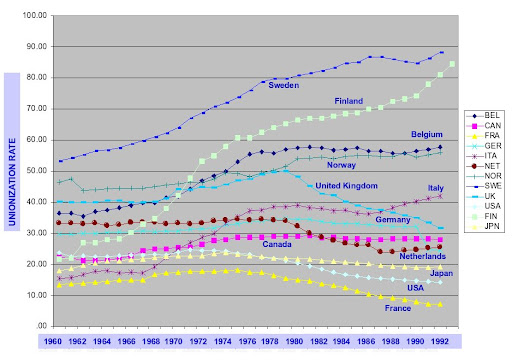
the problem sets that I was doing as part of my prep for an exam includes a graph about unionization in OECD countries. Shown adjacent (courtesy Bowles, 2006 from Luxembourg Income Survey Data). (aside: Roberts also argued that the change began in the 50s, I don't have data on that period).
Now if the assertion that a shift to services, which Roberts asserts drove the change, and which has occurred in most of the OECD countries is 'the reason' behind the de-unionization of the US then this de-unionization should occur throughout the OECD. If not, then not. (Note I am struggling to find a paper/data on this change cross country, looked at some data from the OECD factbook).
Which begs the question, what are the real reasons? Were I a better labour economist than I am, I could probably tell you in detail. What I can talk about is one of the models that we looked at in the course was a behavioural updating model in which you would expect a priori for there to be local homogeneity and global heterogeneity in the distribution of some trait in which there are certain empirically observable characteristics and which the model can replicate (depending on parameter values), in the case of this study the trait union density. What does this mean? With certain starting conditions, and certain random perturbations, or alterations in institutional setting (acceptability of being in a union say, or lack of union-breaker politicians such as Thatcher and Reagan) you would expect there to be differences in the distribution of unionization, even if countries started at relatively similar starting points, i.e. the divergence we observe in the graph above. Things like culture, politics and historical contingency (path dependence) enter as a factors into these models, which, for me, gives them more flavour, but which for others could be problematic.
I will give a technical analysis of it in a couple of days time if anyone is interested. If so, get ready for some LaTex2html...
Please note that the model is not meant to 'explain' unions and unionization, but is intended instead as a description of what could be a reason (given institutional setup and other factors) and to which Roberts' point could be a contributor. I just don't believe that his argument holds water as the sole explanation in the face of the data.
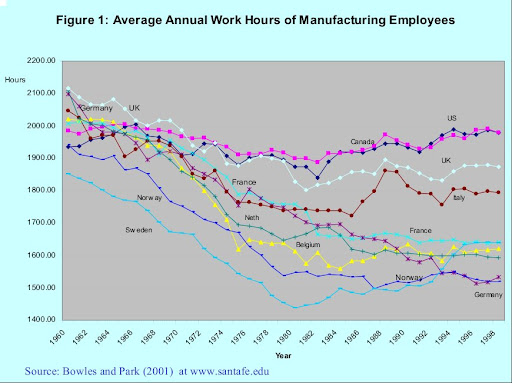
Edit: I found another graph that could be interesting in the context of the above.
He argues that unionization rates in the United States dropped on account of the movement away from labour intense work, such as manufacturing and agriculture. He argues that they had moved from this into industries in which there wasn't as much of a need for unionization (lack of harsh conditions, etc), such as the service industry.
So that, in and of itself, isn't an unconvincing argument. So I went andlooked at one of my textbooks to see if I could find anything about
unionization rates. Lo and behold (and quite serendipitously), one of
the problem sets that I was doing as part of my prep for an exam includes a graph about unionization in OECD countries. Shown adjacent (courtesy Bowles, 2006 from Luxembourg Income Survey Data). (aside: Roberts also argued that the change began in the 50s, I don't have data on that period).
Now if the assertion that a shift to services, which Roberts asserts drove the change, and which has occurred in most of the OECD countries is 'the reason' behind the de-unionization of the US then this de-unionization should occur throughout the OECD. If not, then not. (Note I am struggling to find a paper/data on this change cross country, looked at some data from the OECD factbook).
Which begs the question, what are the real reasons? Were I a better labour economist than I am, I could probably tell you in detail. What I can talk about is one of the models that we looked at in the course was a behavioural updating model in which you would expect a priori for there to be local homogeneity and global heterogeneity in the distribution of some trait in which there are certain empirically observable characteristics and which the model can replicate (depending on parameter values), in the case of this study the trait union density. What does this mean? With certain starting conditions, and certain random perturbations, or alterations in institutional setting (acceptability of being in a union say, or lack of union-breaker politicians such as Thatcher and Reagan) you would expect there to be differences in the distribution of unionization, even if countries started at relatively similar starting points, i.e. the divergence we observe in the graph above. Things like culture, politics and historical contingency (path dependence) enter as a factors into these models, which, for me, gives them more flavour, but which for others could be problematic.
I will give a technical analysis of it in a couple of days time if anyone is interested. If so, get ready for some LaTex2html...
Please note that the model is not meant to 'explain' unions and unionization, but is intended instead as a description of what could be a reason (given institutional setup and other factors) and to which Roberts' point could be a contributor. I just don't believe that his argument holds water as the sole explanation in the face of the data.
Edit: I found another graph that could be interesting in the context of the above.
Subscribe to:
Posts (Atom)