


Friday, October 24, 2008
Joseph Stiglitz - A Crisis of Confidence
Jeffrey Sachs - Seven Questions
Tim Harford - Econopoly
Robert Skidelsky - We Forgot Everything Keynes Taught Us
Dani Rodrik - The Next Stage of the Crisis
Other:
Chrisopher Hitchens - Vote for Obama
Chris Blattman - Interview with Ray Fisman and Ted Miguel

Thursday, October 23, 2008
Religious Norms, Human Capital and Risk
Under reasonable assumptions, we show that any implementable norm can either enforce charity or extra effort provision, but not both at the same time. The features of the most desirable norm depend on the relative importance of pure hazard (luck) and returns to effort, suggesting that in early development stages charity norms are more desirable, while norms supporting effort provision and self-responsibility are dominant when returns to human capital are relatively high and safe. This is consistent with the observation that the Catholicism is based on norms of charity, while Protestantism promotes self-responsibility and industriousness.They basically argue for an endogenous, and basically inevitable, 'reformation' of the church as a consequence of life becoming 'less risky'. This lower risk resulted in guarantees to returns to human capital investment that could not be achieved before (the reformation). The factors that determine religious adoption had to do with the size of the returns to human capital and exposure to risk. Prior to the reformation, risk was high and returns to human capital investment (if not investment generally) were quite low. One of the norms which could allow for insurance in this instance would be one based on 'mutual insurance and charity', which the authors identify as a 'Catholic' norm. However, once the returns to human capital increase and size of or exposure to risk decreases norms that support increased effort provision are, instead, a better method (i.e. a approximate a first best solution in a general equilibrium framework) of insurance. This is similar to the 'Protestant', Calvinist, or Puritanical systems. The paper is a work in progress and they are still look at combinations of the two, i.e. systems in which there is partial mutual insurance and substantial - but not extreme levels of - effort provision. They are still working on the math of this, but it looks promising. Basically, they should be able to cater to a continuum of religions on a line of 'effort provision' to 'mutual insurance' with signals of what are likely to be specific 'sins' in one religion (norm set) vs. another.
One of the consequences of this research is that if the division of religions was, in fact, endogenous then the use of religion as an 'exogenous' variable in cross-country regressions as a proxy for culture is deeply problematic. This obviously has a consequence for using such variables as an instrument for culture and thus, when published, the paper should have a substantial impact on the empirical work using 'religion' as a proxy for underlying, unobservable characteristics in a country.
Friday, October 17, 2008
Call for Posts - Carnival of the Africans # 3
I start my second year of PhD coursework on Monday the 20th, so please do me the little favour of getting the posts into me that day early so that I can get all of the reading done. Send in posts that are preferably, but not exclusively, written and published during the last month.
The Carnival of the Africans is a carnival based on similar principles to that of the Skeptic's Circle, but with a distinctly African flavour - science by Africans for Africans if you will. If you plan to send in a post, please make sure to look at the guidelines set out by Ionian Enchantment here. Closer to the time I will do my best to contact specific people if I have read blog posts that I would like to have included in the carnival. Please send me the URLs of, or links to, up to three posts that you would like to have included in the line-up of the carnival.
If you would like to take a look at previous carnivals, then take a see that past two carnivals:
Ionian Enchantment hosting the Carnival of the Africans #1.
the little book of capoeira hosting the Carnival of the Africans #2.
I look forward to hearing from you soon! Remember that carnivals are a fantastic way to promote your blog and to get your name out there into the blogosphere. I anticipate fantastic posts.
Tuesday, October 14, 2008

Luigi Zingales - Plan B (very good)
Vernon L. Smith - There's No Easy Way Out of the Bubble
Ben Bernanke - We're Laying the Groundwork for Recovery
Vox EU Publications - Rescuing Our Jobs and Savings
NYT - US investing $250 Billion in Banks (this is simply wow, almost unbelievable, part of me is worried about the 'preferred stock' idea, but not too sure right now, see graphic adjacent)
Vox EU - Financial Development at Risk
Cass Sunstein - Wall Street's Lemmings
Vox EU - Richard Portes - A Strategy Emerges
Non-financial:
Vox EU - HIV and Fertility in Africa
Vox EU - Never Trust a Stranger
And by the recent Nobel Laureate Paul Krugman
(all old pieces):
The Ice Age Cometh
Size Does Matter
Incidents from my career
How I Work
Ricardo's Difficult Idea
 At least for Iceland, the import-dependent country of 320 000 inhabitants: the Icelandic currency, the krona, has depreciated so dramatically while its three main banks went bust that imports have frozen up because foreign currency has become unavailable. Markets are clearing, not in the economic sense, but in the sense that they are really drying up of goods. It makes the optimist in me worry.
See the Bloomberg article here.
Monday, October 13, 2008
Paul Krugman - Nobel Laureate
So a couple of questions, if 'capitalism is failing' why do you still see groceries in your grocery store or supermarket? Why do you still see people in coffee shops being supplied with coffee in all its caffeinated (or not) glory? Why are people still selling and buying cothes at department stores and flea markets, going to movies, worrying about methods by which they can use the market and the mechanisms by which the market operates - i.e. those other agents in the market who we expect to go about allocating their resources to satisfy their wants - to make sure that we can satisfy our own wants. How is it that if you want something (and you have the money to buy it) you can go out and get it? The answer: a functioning market system.
This is not to say that I am overly optimistic about what is going to happen in the world economy over the next while. Do I expect that unemployment will increase as a consequence of the financial crisis? Yes. Do I think that it will be more difficult to get a loan and therefore for the market to operate as fluidly and responsively as before. Yes (which is a strong reason for injecting liquidity and recapitalizing the financial system). Do I think people will have to cut back in their spending? Yes. Do I think there may be issues with inflation and devaluation of capital? Yes. Do I think we should suddenly jump ship and decide to implement a communist regime of centralized government planning for all goods and service? No. No. No.
Mark Thoma puts it well:
As we are seeing now, sometimes markets can fail catastrophically, but that doesn't mean that all markets fail, or that we should lose faith in the ability of markets to allocate goods and services... Every day... the needs of hundreds of millions of people are met through our market system. For the most part, when you go to the marketplace, you can find what you want -- somehow, the market anticipates your needs and has the goods and services ready and waiting when you walk through the door of a store. You won't always find what you are looking for, stores can stock out, oversupply, not have what you want, and so on, but most of the time you do find what you are looking for, or don't have to wait long to get it. When you think about it, it's actually pretty amazing that we are able to coordinate so many diverse actions of so many individuals into an economic system that does a pretty good job of providing for our needs, responding to changes in our tastes, providing incentives for technological advancement, and so on. So I don't think the lesson of this crisis is that markets don't work. I think the lesson is that markets don't always work, that we need to be vigilant in our oversight of markets to make sure they really do satisfy, as much as possible, the competitive ideals that are necessary for markets to perform well.
This is fantastically sensible in my mind. Thoma was lauded for his prescience of the way in which the financial crisis would turn out and I recommend his blog Economist's View. I just want to make sure that people don't incorrectly interpret the current crisis as something that it is not - it is not a call for the dismemberment of markets, it is a call for oversight and recognition that legislation needs to keep up with the technology and pace of the financial system. It has not done so. We are feeling the consequences of both market failure and government failure now.
And now for a video of Charlie Rose interviewing Paul Volcker:
Thursday, October 09, 2008
Financial Crisis Links
Gary Becker - We're not headed for a depression
Avinash Persaud - How Risk Sensitivity led to the Greatest Financial Crisis of Modern Times
James K. Galbraith - Goodbye, Conservatives. Hello, Predators
Esther Duflo - Too many bankers
Mark Thoma - What Caused the Financial Crisis
Christopher Carroll - Capitalism and Skepticism
Paul Romer - Fundamentalists vs. Realists
Mark Thoma - The Bernson Plan
Paul Krugman - The International Financial Multiplier
Tuesday, October 07, 2008
Egalitarians behave 'trustworthily', Egotists don't

The main reason that it is of interest to me is that it used a sample of students from South Africa in Cape Town (which somehow was spelt Capetown in the paper, ATROCIOUS editing!), along with students from Boston, US and Moscow, Russia.
The next point of interest is that, unlike many economic experiments, it assesses within-subject variation across two different games, the dictator game and the trust or 'investment' game.
The authors had 4 main hypotheses that they wished to test:
- Trust is only based on expectations of trustworthiness.
- Trust is only based on unconditional kindness.
- Trustworthiness is only based on reciprocity.
- Trustworthiness is only based on unconditional kindness.
With respect to their hypotheses, they find that, "trustors derive satisfaction from trusting independent of amounts expected back and unconditional kindness" (201). This dismisses hypotheses 1 and 2. With respect to hypotheses 3 and 4, they find that "[In] contrast to trust, unconditional kindness accounts for most of the variance explained while reciprocity plays a comparatively small role" (202-204) but, "Overall, we reject both our hypotheses" (202) they do this because their results seem to explain approximately 20% of variation, which they do not feel is sufficient to 'prove' their final hypothesis.
This doesn't give us much insight, however their one conclusion is quite interesting, in response to the question posed by Camerer “What game do people think they are playing?”, they argue that:
Our results suggest that many people may play a different game than researchers thought they were playing when confronted with the “investment game.” Only 36 percent of the 159 trustors who decided to send any money in our “investment game” expected to make money (204).Moreover, one of their final points is that:
Our design allowed us to solve one of the important trust puzzles, namely that people trust even though hardly anyone makes money by doing so. We found that generally, people are aware of this. They trust even though they know it does not pay monetarily. They enjoy the act of trusting and being kind to others, even to anonymous strangers (204).This paragraph makes sense to me, up to the point when they say 'enjoy'. In a world where people get windfall cash (as that is basically how experimental money often is thought of, see John List, 2007) people might behave as if they enjoy giving away money to others or as if they 'enjoy' trusting others, but I remain unconvinced that they actually derive 'joy' from such acts in the real world.
Which makes me speculate. What if you could run experiments, and then have a 'beggar' set up outside the experiment (not actually a beggar but an actor, or something) and you gave the individuals the money and then you observed, after the experiment how many individuals chose to give to the 'beggar'. Apart from the 'deceiving the experimental subjects' problem, this might be interesting to observe and to see whether individuals behave consistent with their experimental generosity and 'enjoyment' of giving. It is this correspondence of field observation and experimental economics that requires propagation and increased funding in order for us to validate within subject variation and validity of our laboratory results.
Reference
Nava Ashraf, Iris Bohnet, Nikita Piankov (2006). Decomposing trust and trustworthiness Experimental Economics, 9 (3), 193-208 DOI: 10.1007/s10683-006-9122-4
Experimenter bias is not a well-covered topic in the area of experimental economics, either because those who decide to test it don't find anything worth reporting, or those who do attempt to test it struggle to be published. Who knows?
Nevertheless, a 2004 working paper by Alessandro Innocenti and Maria Grazia Pazienza addresses the question of experimenter bias with respect to the gender of the experimenter. They used the trust game with various treatments to check whether the gender of the experimenter changed any of the responses by the subjects. The trust game involves a pairing of two individuals (a sender and a receiver), the sender chooses to 'invest' an amount in the other person (trust element), this amount is then tripled in value and the receiver may then choose to send some money back to the sender (reciprocity element).
There results were as follows:
- There was no evidence that the gender of the experimenter affected the degree of trust.
- The presence of a female experimenter was correlated with a statistically significant higher degree of reciprocity.
- The effect (of female experimenter reciprocity inflation) occurred across the genders of the subjects, i.e. it was not a 'correspondence' effect of woman-to-woman as some might argue.
The main point here is that the fact that the presence of a female experimenter was correlated with increased reciprocity is problematic for experimental economics and requires several pertinent points for its investigation. First, any experiments that might have historically been carried out with women only as experimenters, without variation across the gender of the experimenter could result in over-statement of the reciprocity of individuals. I could not find specific references right now where this could be the case, but it is worth keeping in mind. Second, it begs the question of how we can do an experiment with the gender of the experimenter unknown. Ideally, we would like to be in a world where we could test the relevance of both male or female gender experimenters against some neutral 'non-gender'. Unless we do not have an experimenter present and disembodied instructions being given to the subjects, I do not see how this could be dealt with. Third, it informs future research because it informs us that we must do one of two things: either have male experimenters for whom the results do not seem to be inflated, or have male and female experimenters while controlling for the gender of the experimenter in the experiments. This second option is a bit problematic because it requires us to have larger samples in our experiments, but it seems to me to be the only way that there can be some kind of equitable way of doing this. Fourth, even though there seems to be a correlation of the gender of the experimenter with higher reciprocity, we do not know why this might occur. This requires further research.
It must be said that, personally, I would like to engage in similar research in the future, but using treatments across the race of the experimenter. I think that this would be especially pertinent in South Africa where there might (I insist, might) be differences in responses of individuals when there is variation across the race of the experimenter, holding gender constant of course. What do you think?
Monday, October 06, 2008
Financial Crisis Stuff
As the token economist amongst friends and family, I thought I would recommend the following links on the current financial crisis.
First, Wikipedia has a fantastic timeline of the current crisis, under the title 'Subprime Crisis Impact Timeline'.
Second, you can peruse these useful notes by Roger Congleton of GMU (they follow the GMU line somewhat, so take the ideology of them with a pinch of salt, but read them anyway).
Third, there is a new blog documenting the financial crisis: The Money Meltdown.
Fourth, there are several blogs that I read with commentary on the crisis that I would recommend: Marginal Revolution, The Semi-daily Journal of Brad DeLong, Greg Mankiw, Paul Krugman and Mark Thoma's Economist's View. Mankiw regularly gives interesting and brief insights, as well as giving links to good articles by prominent individuals. Thoma cites articles at length and gives his own commentary.
Fifth, don't believe what everyone has to tell you about Adam Smith and the financial crisis. Read what Gavin Kennedy has to say here, here and here on his blog 'Adam Smith's Lost Legacy'.
Sixth, Duncan Green, the head of research for Oxfam, maintains a blog and has couple of posts on the topic of the financial crisis and development, the most interesting post of which is a discussion of what $700bn would do for global development.
Lastly, some audio and video stuff. EconTalk host Russ Roberts chats with Arnold Kling on the role of Fannie Mae and Freddie Mac. I found this very useful for helping me to understand what exactly they did and, thus, how they impacted on the financial crisis. Roberts also interviewed Robert Shiller (of the Case-Shiller (housing) index fame) on housing bubbles, which I found interesting. UChannel, another audio and film 'academic' web resource, has a discussion featuring Paul Krugman and Alan Blinder, both of whom have been quite outspoken on the crisis and its possible solutions. Krugman especially is a fan of nationalizing Fannie and Freddie.
Ok, that's enough for now and should sate any financial crisis appetite for the moment.
Thursday, October 02, 2008
...to those at Intrade. It looks like Obama has overtaken McCain substantially once more. Ahhh... the effects of Pa(l)in bring me joy.
Wednesday, October 01, 2008
FT - Zuma Will Struggle To Fulfil Pledges to Poor
AfriCan - Financial Market Turmoil and Africa
Economix - Names for the Bailout
AP - Understanding the (US) Black-White Earnings Gap
McCain's Lies:
And a fantastic mock loan interview:
Tuesday, September 30, 2008
Bad Reporting
This article-post on the Freakonomics blog was indicative of the poverty of reporting on psychological and economics findings. I found it dreadfully uninformative. How can it simply be said that 'chauvinists are more likely to earn more'? Could it not be that individuals who are successful end up as chauvinists, rather than that chauvinists end up successful? What were the other controls? What other variables did they consider? What did they rule out? Why did the article adopt causative language? In my opinion, there is probably so much going on in the formation of beliefs about 'gender' that just isolating one belief is basically arbitrary. I turned to the original article to find out more.
Barring the comment in the post on the fact that the sample was constituted of Americans, most of the subsequent phrasing makes it seem as though, in general, it 'pays' to be chauvinistic. This is not necessarily a general relationship as it is for a specific sample of US individuals. See my correlation-causation fallacy comment above.
Next point, in the paper the range of ages is 8 years (those 14-22 in 1979) because of the way the sample is constructed. Thus this is a measure of gender bias for this specific generation, but does not necessarily inform us as to the gender bias of later generations or age cohorts. Again, generalizing from this age cohort is perilous. Thus, the above shouldn't say 'Men' it should say, 'Men in the US who are currently between the ages of 43 and 51'. The Freakonomics post wasn't specific at all. The article was substantially more specific, though it too over-generalized on occasion.
Also, don't forget that the paper reports how, '[M]ore educated people and more intelligent individuals were less likely to have a traditional gender role orientation' (p.1002) and that 'individuals raised in religious households were more likely to have a traditional gender role orientation' (ibid). Which, to me, indicates that there are, quite possibly, problems of endogeneity in the model. What does this mean? Well, the consequence of this kind of thing is that the standard errors of the coefficients (the betas) are meaningless. Why? Well, if you have a variable which is meant to be measuring some effect, but there is a relationship between this variable and the error term in your regression (through bidirectional causality, simultaneity, or missing variables) then what you are actually measuring is the bias as a consequence of one of these effects. I, for one, do not believe that the index constructed in the paper actually identifies anything [see this wiki article on instrumental variables, 2SLS and identification for basic econometric protocols in this kind of situation].
Consequently, we do not know whether the coefficients are actually significant. What does this imply? For one, that the actual end result is meaningless - we don't know whether there is a positive and strong relationship involved because we could be measuring anything that is related to the index that they construct and the error term. What does this mean? Well, a host of other variables could actually be driving the higher income variable any of which could be itself correlated with chauvinism. So they are not identifying anything causative!
Now, why does this kind of reporting incense me? The main reason is that an uninformed and unskeptical chauvinist pratt could read the article and use it as justification for their own behaviour. They could internalize the idea that 'chauvinists earn more' (when we can't actually conclude anything of the sort from this research) and they walk away believing their chauvinism justified. Notwithstanding this, scientifically the article was a mess. It was unspecific, it overgeneralized and it misrepresented the outcomes from the article. It reminds me, once again, that so much education is needed for the populace at large in order to ensure that readers of such a post don't get dumbed down by it and read it at face value.
Sunday, September 28, 2008
Carnival of the Africans #2
Wim Louw over at the little book of capoeira is hosting the second Carnival of the Africans, to which I contributed three pieces, my piece on having a large disadvantaged (I forgot the final d in the original piece's title, silly typo!) populace but wanting to create equality, my piece on herbal remedies and my piece on Egalitarianism in young children.
Saturday, September 27, 2008
Stupid, stupid crack reporting
I sent them the following letter:
To Whom It May Concern,
The article mentioned above inaccurately prints that Danie Krugel is an 'academic'. To be an academic an individual is required to be affiliated with a university or a recognised research institute. Danie Krugel is therefore not an academic. That you have printed such information does your publication a terrible disservice. You have perpetuated the belief in the veracity of Mr. Krugel's 'machine' and thus you perpetuate unscientific thinking and reporting based on lack of evidence. This is horrific for a publication that is meant to report solely based on facts. Please ensure that you correct this atrocious misrepresentation.
Best regards,
Simon Halliday
PhD Student, Facoltà di Economia, University of Siena, Italy
South Africa's current account is not as disease-ridden as some might argue, but some of the 'solutions' as proposed by individuals such as Zwelinzima Vavi to 'discipline' businesses are bound to do more damage than good. This is the main thrust of this recent Vox EU article from Peter Draper and Andreas Freytag.
Thursday, September 25, 2008
Who doesn't pay?
So, let me take a couple of views on responsibility and accountability.
First Thomas Scanlon (1988, 176):
[W]hat is required for moral appraisal on the view I am presenting is the freedom, whatever it may be, which is required by critically reflective, rational self-governance. But this is less appropriately thought of as a kind of freedom than as a kind of intrapersonal responsiveness. What is required is that what we do be importantly dependent on our process of critical reflection, that that process itself be sensitive to reasons, and that later stages of the process be importantly dependent on conclusions reached at earlier stages. But there is no reason, as far as I can see, to require that this process itself not be a causal product of antecedent events and conditions.And then John Roemer
[T]o hold a person accountable for an action will mean that he should pay for it - he should, perhaps, compensate others who were harmed by the action, or be penalized by society for it. (Roemer, 1998, 17)And Richard Arneson (2000, 12) elaborates usefully,
[O]ne is responsible for a choice (that affects only oneself) when one is allowed to absorb its costs and benefits for oneself without compensation.Now Paulson, in his plan, says that we should not 'constrain CEO compensation' during streams of retrenchments that could feasibly occur as a consequence of the current crisis. [Aside: Paulson is an ex-CEO of Goldman Sachs and is worth several hundred million dollars himself.]
Many of the CEOs involved in those companies which have fallen during the current crisis are directly responsible and accountable for the actions that have occurred. They championed policies that led to the use of risky assets and the selling of mortgages to risky individuals - they are responsible. However, Paulson is arguing that we should not hold them at all accountable (As Paul Krugman comments, "Demands for complete discretion with zero accountability"). As a consequence of their actions taxpayers in the US will have to pay at least 700bn USD (that's billion, not million as some have misreported, comment here). Moreover, thousands will have lost jobs, money and houses as a consequence of actions and policies adopted by CEOs on Wall Street. Consider an individual who had saved money, worked hard and was in permanent employment at the low end of one of these firms, did not take part in any of the risky business, but has lost investments (hopefully not their home), their job and now has to pay, possibly in perpetuity, through taxes to BAIL OUT those whose actions resulted in him losing his money, losing his job and having to pay more taxes.
On top of this, Paulson does not want limits on CEO pay packets, for them to be able to walk away with 'golden parachutes' to be rewarded more money by the boys club of CEOs even though they are the ones who should lose money, lose their jobs and be held accountable for their actions by the public and by government for the riskiness of their actions. He basically wants a blank cheque. I am not even going to go into the Moral Hazard aspect of what this does for incentives.
So, what the plan does is to capitulate to the wants of those who don't want to be held responsible. It banks on the fact that the individuals who are so greatly affected on 'main street' want something to help them and therefore allow those responsible not to be held accountable because of the depth of their own suffering. Allez the CEO boys club! Allez!
I am with Mark Thoma when he says:
Peoples' lives are nothing to be toyed with, and if a bailout is the only way to avoid the chance of massive meltdown and widespread job loss, so be it. Protect Main Street first and foremost, but give away as little as possible to Wall Street in the process.However, none of the above takes into consideration the extent to which individuals will pay taxes as a a consequence of these bailouts. I agree with David Colander when he says that “What matters is what price they buy the assets for and the price they sell them for. That’s where the real action is.” Why is this the real centre of the problem? Well, depending on how much the US Treasury Pays (and therefore how much taxpayers have to pay over the next while) the level of the risk borne by the US Treasury (and thus by taxpayers) increases or decreases.
As David Leonhart of the NYT argues:
It clearly shouldn’t pay 75 cents on the dollar, or anything close to it. That would mean the Treasury Department — which, in the end, is really you and me — was assuming nearly all the risk. But it probably can’t pay 25 cents. That might fail to fix the credit markets, becauseAnd finally, from the open letter by economists on the plan that was just sent to congress:
it would do relatively little to improve financial firms’ balance sheets. Firms might then remain unwilling to lend money to businesses and households, which is the whole problem the bailout is meant to solve.
Its fairness. The plan is a subsidy to investors at taxpayers’ expense.And as Hillary Rodham Clinton comments:
Investors who took risks to earn profits must also bear the losses. Not
every business failure carries “systemic risk.” The government can
ensure a well-functioning financial industry, able to make new loans to
creditworthy borrowers, without bailing out particular investors and
institutions whose choices proved unwise.
[T]axpayers are being asked to bear an unparalleled degree ofSo there are two crucial things for me:
financial risk. We cannot allow taxpayers to take on this burden so
that Wall Street and the Bush administration can hit the "reset
button." This historic intervention demands a historic shift in
priorities: an end to the broken culture on Wall Street, and the broken
economic policies in Washington.
- CEO payouts should be limited
- The US Treasury and tax payers should not be bearing all the risk the CEOs and those who took the risks unnecessarily should take it, should lose their jobs and should not get additional benefits.
A good quote from a prosecutor, Almeno Soares, in Brazil: "We confuse racial coexistence with racial equality."
I also liked the idea of linguistic equality in the 4th video, but in a country like South Africa with 11 national languages should what constitutes 'linguistic equality'?
HT: Neuroanthropology.
Wednesday, September 24, 2008
A Blog You Can't Leave Behind
I am going to submit a couple of pieces and will let you know, when I have read the others, what I think and which ones I enjoyed.
Tuesday, September 23, 2008
Who You Marry and Persistent Inequality
Lane Kenworthy, a professor at the University of Arizona, Tucson, spoke at the CRISS workshop which I attended this last weekend in Rome. I will comment briefly on one of the concepts, marital homogamy, that he introduces in the first chapter of his book Jobs With Equality which is available online. I know that this concept is not new, I know that my discussion of it is not revelatory, I just wonder what people think about the problems that such a phenomenon creates.
How do you intervene in such a situation? What do we do to combat the problem of positive sexual selection by certain characteristics such as level of education? Well, in my mind we cannot legitimately intervene by `preventing' the marriage of individuals who have similar levels of education. This would also create odd incentives, for example they could choose to cohabit and not marry if 'marriage' was the point of intervention. Notwithstanding this funny incentive structure for not marrying, the infringement on individual freedoms would be, for me, problematic. Where else can we attack the problem? Well, how about taking a look at the extent to which characteristics are 'inherited', or affected by peer and neighborhood effects. Let's go along with the literature and say that these effects are strong and positive. Should we disallow school selection by parents and randomly allocate students to schools? Probably not. In all likelihood you would have out-migration of parents with high education who have the most to `lose' in this situation. The reason I say this is that it is unlikely that any policy we enact would allow simple `upgrading' of uneducated individuals to `educated' status, rather you would probably have some kind of reversion to a mean, which might be dispreferred by `educated' individuals.

For us, in South Africa, one of the additional problems is to consider whether there are correlations between race and level of education. There have been such correlations historically, which have also led to persistence in inequality of outcomes. However, let us assume that we can overcome the differences by race and have fairly similar distributions across groups. What then? Do we think that diverging, or even persistently separate levels of education is an adequate outcome? If we don't think it legitimate, as I generally don't, What can we do? Where is it legitimate for us to intervene? Is a society in which there is near zero elasticity of parental education to children's education the optimal society?
I am married. I am pursuing my PhD, my wife is currently completing an MA and plans to do a PhD. We fit the 'maritally homogamous' norm. When we have children, I would like to think that they will choose to obtain higher education. This means that my personal incentive is to ensure that there is a non-zero elasticity for my own children. Is it not true to think that educated parents might believe such a thing on aggregate and perpetuate inequality?
Monday, September 22, 2008
Herbal Mixtures and Traditional Healers
 I know that this blog traditionally deals with economics, but I felt I needed to comment on this subject. In the South African news today there are reports of a herbal medicine mixed by a trainee traditional healer resulting in the deaths of the trainee healer's entire family. My condolences go out to the family and friends of those who have passed away.
However, this opens up one of the many areas in which progress needs to occur in South Africa. I understand and respect the fact that there are cultural differences between groups and individuals. I acknowledge too that there should be autonomous choices made when individuals engage in cultural practices. However, taking 'herbal mixtures' that could result in the deaths of the individuals involved does no seem, to me, to be a 'good' outcome of such cultural practices.
 The skeptic in me rears its head and says, "What would happen if these people did not believe that these herbal mixtures were necessary as part of some religious ritual?" Well, my pat answer is that they wouldn't be dead. They could also be ostracised from their communities, thought of as wrongheaded or counter-cultural on account of having chosen to reject their religion, or their 'cultural practice' (what you will), they could be spending their time doing something else. They could, too, have chosen to join some other religious group and have other, hopefully less lethal, religious or cultural practices.
Ultimately, what it comes down to for me is the fact that, once more, lack of belief in science, belief in witchcraft, or the supernatural, or something entirely not based in science which should have been based on science (being a medicinal herbal mixture, i.e. with visible outcomes). Instead they were based on 'cultural' practices that are, by their nature, not allowed to be touched by scientific practices because of the fact that they are meant to be thought of as 'autonomous', that the 'paternalism' of science will 'damage' the experience of practices that allow scientific intervention or verification of outcomes. This is downright silly. But such silliness seems endemic to supernatural belief, especially supernatural beliefs that claim authority that is independent of scientific verification. As such, people will end up dead. It is a great pity. My condolences go out to the families once more. I am sad that their relatives have passed away, sadder still that it was as a consequence of herbalism
Saturday, September 20, 2008
CRISS Workshop
For the past couple of days I was attending a workshop at the University of Rome, `La Sapienza', hosted by CRISS, a cross-university research group investigating dynamics of inequality, poverty and welfare.
My notes from some of the sessions are available online:
Prof Kanbur's keynote speech was especially interesting as he has done a fair amount of work on South Africa (he is, in fact, off to a conference in SA soon organised by one of his co-authors, and UCT Prof, Haroon Bhorat).
Wednesday, September 17, 2008
Sarah Palin - potential vice president of the US - and her church.
Sarah Palin's Churches and The Third Wave from Bruce Wilson on Vimeo.
Monday, September 15, 2008
Whites, Blacks and Altruism in UCT Students
An Economics Research Southern Africa (ERSA) working paper by Wilhelm Gerhard van der Merwe and Justine Burns uses the dictator game to test altruistic motives in the students. As I have already sent the authors an email with some of my concerns, I am not worried at all about discussing some points about the paper, in fact I hope that more discussion about the paper will improve it prior to its (hopeful) publication. In the spirit of full disclosure: Justine Burns was my 'supervisor' for my MComm in Economics, her husband Malcolm Keswell was my 'boss' when I worked for SALDRU; they are now my 'friends'.
Anyway, back to altruism in UCT students. The authors are very careful in annunciating that the sample that they study should not be seen as generalizable. This is meritorious indeed as far too many people don't make this kind of point sufficiently strongly in their research (including Ernst Fehr on whose recent work I commented a couple of days ago).
The construction of their experiment is as follows. It uses a classic dictator game with samples of students who are randomly paired. They run a control dictator game and then introduce a treatment that reveals the surname of their opponent in order to convey their racial/ethnic group. Their results indicate that the introduction of this information, in general, increases, i.e. simply knowing something about the partner increases the payoffs in general. White proposers make significantly higher offers than Black proposers. White proposers also seem to favour insiders with the median offer in a white-white pairing being double the offer in a white-black pairing. There does not seem to be insider bias for black individuals.
I have one or two concerns, which, as I said, I mentioned to the authors. The main one is about the inclusion of 'altruism' in their title and in the text. I don't believe that the patterns that are observed should be discussed as necessarily altruistic, but could, instead, be indicative of a host of differing theories see Bardsley, 2008; List, 2007 and Levitt and List, 2007 on this. The authors don't place too great a weight on the term altruism, so I don't think that it will be a problem for them to negotiate this problem.
Otherwise, I don't have any major methodological issues with the study and I believe that it is informative and should be replicated, eventually with a more representative sample of the population (this is something I'm particularly interested in seeing, or even doing at a later date). There are one or two issues in how things are presented, but they will be ironed out as the paper goes through iterations of review I am sure.
Please read the paper it is quite short and I think that Justine and Wilhelm would appreciate any feedback I could give them from anyone who reads this blog. It is available free of charge from the link in the first line of the post.
We were engaged in an orgy of imprudent risk taking for nearly a decade and now a heavy price will be paid for the violation of so many simple and common sense precepts of trading.'Orgy of imprudence' is such a fantastic phrase. I'd love to use that in a lecture. But I (like Mark Thoma) worry about that last line.
I truly fear for our economy and our system the next several days.
So Bearn Stearns, Merrill Lynch and Lehman Brothers: 0, Credit Crisis 3 (I'm giving FNMA and Freddie Mac the benefit of the doubt here, even though they also 'died'). Bets on the downfall of Goldman Sachs and Morgan Stanley are open. Oh yes, something's wrong with AIG too.
Sunday, September 14, 2008
Egalitarianism in Young Children
The experiments on which the paper was based were run with children ranging from 3 to 8 years of age where children would choose allocations of jellytots, smarties or fizzers for themselves and a partner. There partner could be from their kindergarten or playschool (in-group), or from another (out-group). There were three treatments in the experiments.
- 'Prosocial Treatment' choosing between a (1,1) and a (1,0) allocation.
- 'Envy Treatment' choosing between a (1, 1) and a (1,2) allocation.
- 'Sharing Treatment' choosing between a (1,1) and a (2,0) allocation.
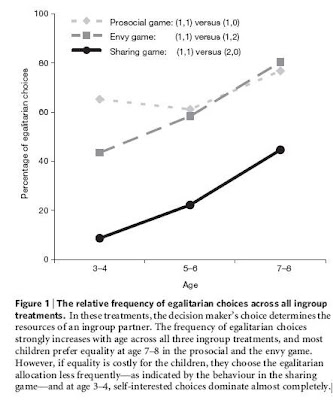

In terms of parochialism (or in-group vs, out-group motives) there was significant evidence to indicate that the children favoured in-group members, as the authors comment: "The egalitarian choice is 15-20% more likely in the prosocial game if the partner is an in-group member" (1081). Moreover, parochialism seems to develop concurrent with egalitarian motives, as the favouring of in-group members was much greater amongst the 7-8 year olds than for the younger participants.
The authors also note an interesting gender disparity with boys seeming to be more parochially inclined than girls were, quoting again, "boys seem to be much less averse against disadvantageous inequality if the partner is an ingroup member [...] In contrast, girls do not differentiate in their choices between ingroup and outgroup partners" (1081). This seems to be in line with modeling that considers the coevolution of altruism and parochialism, with men going to war against the outgroup and possible selection for in-group favouring males being active.
The authors also make some attempts at interpreting 'birth order' and 'only child' effects. The evidence indicating that only children are more likely to share than others and that youngest children in sets of siblings are less likely to share than others. They also make some comparisons of the evidence they have with evidence from chimps and marmosets, the implications of which I am not going to consider here.
What, for me, is a crucial flaw in the 'child egalitarianism' that they propose is that it is probably in no way as universal as they make it sound to be. This is a nuanced point. They don't state outright that their theory universalizes to most of humanity, but it seems to be tacit in their phrasing. Why is this a problem for me? Well, the sample is entirely made up of Swiss children. According to studies by a co-author of Fehr's, Simon Gaechter (along with Benedikt Herrmann and Christian Thoni), altruistic punishment is culturally conditioned and anti-social punishment seems to be a prevalent worldwide adult phenomenon (I blogged on the impacts of the Herrmann, Thoni & Gaechter paper here and here). In fact, in the Herrmann, Thoni and Gaechter paper the Swiss sample of individuals were among the most likely to act prosocially in the worldwide sample (actually and anecdotally, one of the reasons for the research in the first place was that the Swiss seemed abnormally cooperative to the authors relative to others). This is bound to affect the ways in which children in Swiss society are socialised.
The only deference Fehr et al. are willing to give this concept is captured in the single sentence: "The children probably acquire some of the normative rules of the society which surrounds them during the age period on which we focused" (1082). So they admit that children can be socialised, and that theirs might be, but they don't discuss the ways in which this could jeopardize the generalisation of their theory. Obviously, the problem is that we cannot know whether the tendencies towards inequality aversion and parochialism that they discuss are universal and genetically driven unless studies are undertaken that use cross-country and cross-cultural comparisons with children so that we can capture cultural differences versus inherent dispositions.
Notwithstanding this criticism, I believe strongly that this paper takes a step in the right direction. As much as the Herrmann, Thoni and Gaechter work originated in the labs in Switzerland and from their went on to test prosociality worldwide, this work could also go in that direction to test the origins of prosociality (antisociality) and parochialism.
References
Ernst Fehr, Helen Bernhard, Bettina Rockenbach (2008). Egalitarianism in young children Nature, 454 (7208), 1079-1083 DOI: 10.1038/nature07155
B. Herrmann, C. Thoni, S. Gachter (2008). Antisocial Punishment Across Societies Science, 319 (5868), 1362-1367 DOI: 10.1126/science.1153808
Saturday, September 13, 2008
 HT: Mankiw and BDL.
Friday, September 12, 2008
The Problem of Having A Large Disadvantage Populace
One of the ultimate questions to do with race in society, and specifically in the workplace, is whether affirmative action policies will do anything to alter the landscape of society itself, i.e. whether it will assist us in ending persistent inequalities and getting rid of segregation in our society. A forthcoming paper from Sam Bowles, Glenn Loury and Rajiv Sethi examines the "conditions under which inequality across social groups can emerge and persist across generations despite equality of economic opportunity" (1). This is particularly pertinent for South Africa. What else does the paper set out to do? It argues that these persistences can arise from the extent of segregation in social networks, the strength of interpersonal spillovers in human capital accumulation and the level of complementarity between high and low skill labour in production.
To foreshadow, their crucial result is that if the size of the disadvantaged group is relatively small then integration can occur with increasing levels of human capital for both advantaged and disadvantaged groups. However, if the disadvantaged group is large then segregation worsens and incentives to invest in human capital diminish. I'm hoping that their model is wrong, as much as I think it is rigorously constructed and elegantly derived.
As Bowles et al. comment, "In South Africa under Apartheid group membership based on a system of racial classification was a critical determinant of economic opportunity" (2). The authors differentiate persistence of inequality (consistent lack of convergence of incomes) from its emergence (the factors that lead inequailty to arise from an initial elagitarian distribution of wealth). What then is the problem? To quote again, "A liberal judicial system cannot prohibit an individual's choice of a date, a spouse, an adopted child, a role model, a friend, membership in a voluntary association or residence in a neighbourhood."(1-2) So the issue is that even in a world in which individuals face no statutory discrimination, and even have access to equality in all other realms, social networks - the connections that individuals have with one another - may be segregated. As the authors explain, "Voluntary discrimination in contact can give rise to persistent group inequality even in the absence of discrimination in contract." (2, original italics)
So how does discrimination in social networks result in persistent group inequality? The short answer is, "Through the human capital mechanism." What I mean here is that even if individuals have the same innate ability because they are surrounded by individuals with different levels of human capital (for historic or other reasons) this disparity may give rise to persistence of group inequality over time. The model proposed by Bowles, Loury and Sethi provides a rigorous mathematical exemplification of this. They model an overlapping generations model with a competitive, non-discriminating (i.t.o. 'group') labour market. They separate workers into two arbitrary groups, both of which have the same underlying distribution of 'ability'. Employment depends entirely on one's investment in human capital, which they take as a decision by one's 'parents' (in the model). There are 'spillovers' of one's own investment in human capital to those in one's group.
Their first insight from the model is that there is a threshold level of segregation above which there will be persistent group inequality, below which group inequalities will tend to converge - i.e. equality will emerge between groups. What this means though is that if your 'economy' has a level of segregation that is close to this threshold then little interventions will surely assist in overcoming the persistent group inequality and equality will emerge over time. If you are particularly distant from the threshold level, then even large attempts to eradicate segregation may not bring you closer to greater equality unless they are large enough to take you under the threshold. What does this mean for South Africa? Are the attempts by government and civil society sufficiently large to take us towards the threshold? I don't know. I'd suspect not.
They then take a look at a situation in which, instead of there being only two 'equilibria' (i.e. states to which society tends) as in the above, there are multiple potential equilibria. Here the insight becomes that the size of the historically 'disadvantaged' (in terms of human capital in its social networks) group becomes a critical determinant of the persistence of group inequality over time. Quoting extensively from the text,
Here we find that the population share of the initially disadvantaged group plays a critical role. If this share is sufficiently small, integration can result not only in the equalization of income distributions across groups, but also in an increase in the levels of human capital in both groups. Under these conditions integration might be expected to have widespread popular support. On the other hand, if the population share of the initially disadvantaged group is sufficiently large, integration can give rise to a decline in human capital in both groups and, if this result is anticipated, may face widespread popular resistance. (4)Reading this paper gave me one of those "I really hope this is wrong" moments that I occasionally get when reading academic work. I don't want to go into any great detail on the rest of the material from the paper, the paper is mainly mathematical modelling. A final conclusion worth noting is their comment that, "equal opportunity alone cannot ensure the convergence of group outcomes even in the long run." (20) Additionally, one of the issues with human capital accumulation is that they are often strongly determined by parents, siblings and other kin. These connections are often highly segregated (inter-racial marriage is not particularly prevalent in SA or the US).
But let's leave on a positive note. They argue that we can still do something:
Finally, as we observed above, contrary to the assumptions we have made here, the degree of segregation may be affected by group differences in human capital attainments. For this reason, temporary policies to reduce these differences, such as lowering the cost to members of the disadvantaged group of attaining human capital, could reduce segregation of social networks which in turn would further reduce or eliminate group differences in levels of human capital. (21)So, as long as we get rid of those pesky human capital accumulation costs in the short run, we might still be able to get rid of group inequality and eradicate segregation! Speculate freely on what this means for policy. Vouchers? Subsidization of education? Cash grants?
Thursday, September 11, 2008
Modern-Era Gender Gap
The point that the blog post makes (based on a paper which the blogger co-authored) is as follows:
In a world in which education garners returns both in the labor and marriage markets, women may overtake men in schooling despite their lower market wage rate and higher amount of housework compared with men. The essence of the argument is that education can serve as a means to escape discrimination for women. In the past, when the labor market return for women was relatively lower, this higher market return was washed out by the lower returns from schooling that women received within marriage. Today, however, women participate more in the labor market and work less at home, as a result of which their returns to schooling within marriage is drastically modified. The reason is that, if women become more educated than men, some of them have to marry down to match with uneducated men. Due to spousal competition in the marriage markets, this raises the 'value' of uneducated men in all marriages. Consequently, men’s returns from schooling within marriage decline (or do not rise much) while women’s returns rise beyond the market return. With the return to education for men fallingReally interesting insights. The idea that discrimination can result in 'over-education' of a group is interesting. I plan to read the paper and will report back when I do.
in the marriage markets, their incentives to get educated do not rise as much as women.
Wednesday, September 10, 2008
Inequality Workshop
So what I wanted to put out there: if you had a question to ask somone of Kanbur's calibre on South African inequality, what would you ask them? I'm thinking of putting myself out there and asking hopefully interesting questions.
Tuesday, September 09, 2008
Agent Based Modeling
There are several reasons why individuals are choosing to adopt agent base modeling. Let's highlight a few of them. First, the concept of the representative agent, or applying methodological individualism always and everywhere, can be deeply problematic. Who exactly should this 'representative agent' represent? Should we not instead have a distribution of heterogeneous agents interacting in manners that replicate to a greater or lesser degree the real world, either establishing their own social networks or using geographical lattices for interacting with other agents? Should we not have something more realistic than random matching?
The next question that we should ask is, do agents optimize or do they adhere to rule-based behaviour? Or is it a mix of both contingent on knowledge or information? Leijonhufvud parodies it well in his 'Three Items on the Macroeconomic Agenda', "The economist of today expects to see a solitary representative agent, under the mathematical spotlight on a bare and denuded stage, asking agonizing questions of himself: `What does it all mean?, [...] or `I know I have optimized, but is that all there is?'" The problem of optimizing agents has been examined exhaustively over the past century, with origins in the work of Herbert Simon and others.
Another favourable aspect of ABM is that we can use it to model economies as complex adaptive systems (CAS) and to use the models to observe the patterns that emerge given different sets of parameters. This allows the researcher a greater ability to understand the emergent patters and the macro-phenomena, rather than focusing solely on the atomistic level of the individual. So what is a CAS? To quote John Holland (from the wikipedia site,
"A Complex Adaptive System (CAS) is a dynamic network of many agents which may represent cells, species, individuals, firms, nations) acting in parallel, constantly acting and reacting to what the other agents are doing. The control of a CAS tends to be highly dispersed and decentralized. If there is to be any coherent behavior in the system, it has to arise from competition and cooperation among the agents themselves. The overall behavior of the system is the result of a huge number of decisions made every moment by many individual agents."As can be seen the ideas of cooperation and competition of agents in order to produce possibly unforeseen or unintended macro outcomes fits well into the economic paradigm. For those interested in a good conversational introduction to complexity theory, focusing on the individuals involved, I'd suggest M. Mitchell Waldrop's Complexity. Alternatively another good, and more up to date book is Scott E. Page's Complex Adaptive Systems.
What do practitioners of ABM do? Well they set up computer programs with 'agents' (little programs or automata) interacting in a 'landscape'. A recent and famous example is that of Josh Epstein and Robert Axtell's 'Sugarscape' where they replicated unequal distributions of wealth, seasonal migrations, pollution, sexual reproduction, combat, transmission of diseases and nascent forms of 'culture'. Eric Beinhocker offers a good summary of sugarscape in his book The Origin of Wealth (pp. 80-97).
Let's take a brief look at Sugarscape. We have:
- a notion of physical space (NSEW)
- a source of energy (or base resource) with heterogeneous distributions across the landscape
- the terrain is differentiated: hills, mountains, valleys, etc.
- look for sugar
- move to sugar
- eat sugar
As I've outline above ABM can bring together behavioural criticisms of economics and the physics-based theories of complex systems. Both of these can and do provide relevant and worthwhile avenues of research for future economic and sociological research. Some time this week I'll assess the recent BPS article on behavioural economics and give my thoughts on the discussion between Pete Lunn and Tim Harford. I thought to preempt some of this discussion with a brief review of ABM prior to discussing the relevance of behavioural economics.
Monday, September 08, 2008
Paul Krugman - The Resentment Strategy
EurekAlert - Intellectual Work Induces Excessive Calorie Intake (though I have an issue with the 'causative' language used there)
WSJ - A New View on TV
Deving Stewart - Ending the Nation State Myth
Ed Glaeser - The Dream for a Human Capital Agenda
Ed Glaeser - The Way We Gentrify Now
The Bellows - Response to Glaeser and Gentrification
Economist's View - Small Towns and Big Time Politics
Tyler Cowen and Ezra Klein discuss Palin
Tim Harford - Nudges are for markets not nations
Peter Singer - The Hidden Costs of Money
Swissinfo - Fairmindedness comes with age
Brad DeLong - Is Inflation the Right battle
EurekAlert - Bowling Alone because the team got downsized
Benatar & Shain - Making a mockery of our Rechtsstaat
Sunday, September 07, 2008