


Sunday, April 26, 2009
Those darn Joneses...
Luttmer mans the bulwarks of the 'positional' happiness theory with his phenomenal statistical rigour and his methodical and exhaustive explanations. I will present some of his findings here and leave you to read the paper if it excites you.
Findings

- Neighbours income has a negative effect on reported subjective well-being controlling for a host of potential confounds.
- Particularly, people reference neighbours with similar levels of eduction: the happiness of a person with a degree decreases if they have a neighbour with a degree who earns more than they do. Similar effects occur for those with high school education only.
- The negative effects are more pronounced for people who associate more with their neighbours.
- Individuals living in richer areas report lower happiness on average.
- But, absolute income levels remain pertinent - if your income and the average income of your neighbourhood increase by the same percentages you would be happier.
Consider the following arguments:
- Definitions of happiness change - this can be dismissed because the frequency of arguments between spouses about finance increases as a consequence of neighbour's income increasing, but other types of disagreements did not increase in frequency. Were it simply about definitions of happiness then this would not occur.
- Individual opinions change over time - this is discounted because the data are panel data (cross-sections over time) and Luttmer includes 'individual fixed effects', i.e. he includes variables which check whether an individual's opinions remain constant over time given other factors. They do and the reports on subjective well-being are not responsive to such concerns.
- Omitted individual characteristics drive the results - this is dismissed because of a measure of depression. Arguably, increases in a neighbour's income could affect well-being without altering depression-related variables. Such is the case, neighbours' earnings generally do not affect depression, with one caveat: those who are farthest from being depressed are slightly more likely to be a bit depressed when neighbours' income increase.
- A third argument might consider the role of health, but there was no relationship in the data between neighbours' income and reported health outcomes.

Underlying mechanisms
General finding: satisfaction increases with increases in own earnings, but decreases with increases in neighbours' earnings. However, neighbours' earnings increases satisfaction with the neighbourhood generally (i.e. I like living there because I am in a 'good' neighbourhood), but increases in neihbours' income makes satisfaction with leisure decrease.
Neighbours' income could affect aspirations, but financial worries (about whether family income will be enough to cover bills and food) do not increase with neighbours' income - i.e. the reference points don't increase in this data, contrary to Stutzer's paper that I reported on previously.
However, friendships and social capital could be deteriorating as a consequence of keeping up with the Joneses. I quote from the text:
People appear to be giving up leisure, to allow their friendships to suffer, and to work more, perhaps in an attempt to mimic the material livings standards of their neighbours. (985)This is consistent with arguments that people overestimate the value of consumption (and immediate consumption particularly), and do not take into account the long term effects of deterioration in friendships, family ties and other social capital (more on this soon).

I found this paper well structured, rigorously defended and strongly posed.
It was a pleasure to read and consider. I will have to read more on the topic before I am convinced though that there are not complementary causes through aspirations à la Stutzer.
Post Script
I found the following finding interesting. Jews and the non-religious are significantly less happy. Baptists are the most happy. No significant effects hold for other Christians.


Saturday, April 25, 2009
Happiness & Striving for Money
 Today I comment on a chapter by Stefano Bartolini in the Handbook of the Economics of Happiness. He discusses the role of economic growth in our understanding of subjective well-being and particularly the role that money plays for happiness. He considers trends in expectations about leisure and money, trends in saving and in labour markets. He explains some of the reasons behind these trends.
 Historic Trends
During the 70s economists were debating the coming 'leisure society' with predictions that work hours would decrease to 15 hours per week in the UK because of how society and production were flourishing.
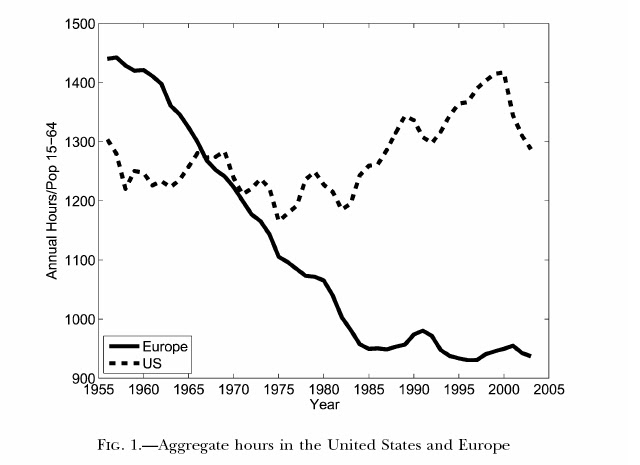
This society has obviously not been realised. Furthermore, economists thought growth would release workers from the need to save to insure against economic shocks. Interest in 'money' was expected to decline. Though mass poverty in the US, UK and EU has been eradicated, we still obsess over money.
The industrial transition - the move from agriculture to manufacturing - saw savings rise to a stable and high level. In post-industrial countries the labour supply went through dramatic changes: from a working day of less than 8 hours to work days of 10, 12, and 14 during and after the industrial revolution. The reversion to 8 hour working days (though many still work more than that) took some time. Industrialisation also saw increases in urbanization. Post-industrial societies also seem geared towards producing goods, rather than leisure. Finally, work hours in post-industrial countries seem to be increasing once more.
Explanations
The question thus becomes, with these patterns, what is making people unhappy? If people are unhappy, why do they not realise it and change their behaviour? Consider t
 he following explanations:
 - Set point theory: With this theory, individual propensity to happiness is a personal trait of largely genetic origin and influeced by personality. Happiness is thus a randomly distributed trait in the population and unaffected by external factors. But, if this is the case, then why do we see increases (EU) or decreases (US, UK) in 'happiness' keeping the gene pool relatively constant?
- Decreasing marginal utility of money: Basic idea: a progressive saturation of needs by material goods - as you get more money it is worth relatively less to you. Consistent with relatively affluent societies having sated basic needs.
- Adaptation (Hedonic Treadmill): Main idea here is that people adapt to a consumption level and then require more consumption to feel satisfied. Aspirations play a role in this (consider yesterday's post). The argument is that humans evolved adaptability to deal with poor circumstances, but this same adaptability makes us dissatisfied with high levels of absolute wealth and consumption.
- Relative Position: Relative position in society, or in a community, is relevant to individual happiness and satisfaction. If relative position counts, then an increase in income for all people in society will not improve subjective well-being because each person's position remains the same.
If people realize that their happiness depends on, say, personal traits, or that adapataion will sooner or later annul the advantages of an increase in income, or that money cannot satisfy needs that are essential, [then] they will react by reducing their efforts aimed at making money. In short, if money cannot buy happines, the labor supply and the saving rate will be highly responsive to variations in labor productivity and wealth. (Bartolini, 2007, 343)But, as Bartolini notes, this does not occur. The opposite occurs. Thus, to predict the patterns of consumption that we see in reality, theories 1-3 need an additional theory about the failure of rationality, i.e. an explanation for why people don't realise that they are unhappy and adjust their behaviour accordingly.
4 means money can buy happiness, but only relative to other the position of other people. It does not require additional assumptions about failures of rationality. Moreover, with the increases in inequality concurrent with the increases in GDP growth that occurred in much of the Anglo-Saxon world this theory offers strong predictions that are verified by reality.
Endogenous Growth
Growth theory should explain the trends in labour supply, productivity and leisure. But, many growth models take the labour supply as given (they assume a working population 'N' and put it into a mathematical model). This therefore assumes that all increases in labour will be dedicated to production. But what about increasing leisure? What makes leisure so bad that we don't include it in our growth models? Well, it turns out that if you include labour-leisure decisions as endogenous variables - variables to be determined within the model, rather than taken as given - then the conclusion that economies can perpetually grow disappears. Including leisure decisions results in decreases in accumulation (people save less), and increases in leisure time (people work less). People do indeed seem to have saved less in Anglo-Saxon capitalist societies of late, but they have increased their work hours, not decreased them. This leaves much to explain.
However, if we incorporate a 'micro assumption' about relative position as a motivating factor, then the incessant need to compete and accumulate could drive perpetual growth while also maintaining a population that, on average, reports levels of happiness that do not seem commensurate with its levels of absolute wealth.
Policy Solutions
Let us assume that the subjective well-being of its populace is important to the state. What should it do to deal with the problem of low levels of happiness? Bartolini proposes three classes of solutions.
- Fiscal Solutions: Income taxes and wealth taxes close the gaps.
- Redistributive Solutions: Inequality increases positional competition - trampling on your neighbours to get to the top. Reducing inequality would reduce this competition.
- Social Solutions: Reduce opportunities for positional competition for 'intrinsically zero sum games'.
 Now, I am not certain about all of these solutions. For fiscal solutions I think consumption should be taxed, not necessarily income or wealth. Why? People try to 'signal' wealth, either proper signaling or false signaling, by conspicuous consumption. The problem, however, is that at the high end of the income scale no (feasible) amount of consumption taxes would result in certain people choosing not to purchase that Maserati, or that ostentatious mansion, nor do they refuse to have their wealth published in magazines and newspapers. I think that there are viable redistributive and social solutions, but I reserve those discussions for later.
None of this, in my view, requires that we get rid of capitalism, as some people argue. Capitalism has allowed the contexts in which people compete positionally to proliferate and diversify: when once you would have to fit a fairly strict 'norm' to be happy, capitalist democracies sustain a plethora of new areas in which people can become important to grow and flourish. There are lots more castles of which you can become the king or queen (or intergender ruler if you prefer). Think about games from chess, to poker, to MMORPGs; about music, from hip-hoppers, rappers, goths, punks and emos; about sports from football, to rugby, running, cycling, field athletics. All of these allow people a place in which to exploit positional joy.
But, at the same time, other resources that sustain happiness and satisfaction have begun to die out and these other things - social capital and the environment - will be the focus of later posts.
Post Script
Bartolini also comments extensively on negative endogenous growth in the chapter, I am reserving that for another post as I think it warrants its own discussion (and me reading one of the papers on the topic, rather than just a few paragraphs).

Friday, April 24, 2009
Aspirations and Happiness

- People experience lower subjective well-being when they have higher income aspirations, controlling for their income level.
- People adapt to their income levels and adjust their aspirations upwards according to their new, higher levels of income.
- The average income of an individual's community affects that individuals aspirations contingent on them interacting with their community, say by visiting neighbours.
- Controlling for endogeneity and for time, a gap between aspirations and reality has a negative correlation with reported subjective well-being.
On adaptation, the idea progresses as follows: individuals achieve a certain level of utility become accustomed to it (adapt) and aspirations kick in making them relatively less happy with their position than they were when they first obtained it. When the gap between aspirations and reality widens, people become less happy (or more unhappy).
 Stetzer's research involves panel data on Swiss households from 1997, 1999 and 2000. Because he has panel data (i.e. repeated cross-sections with the same households) he can get rid of confounds, such as whether income is constant over time, or whether individual or household reported levels of wellbeing remain constant over time. The survey respondents were also asked what level of income they thought would be good or bad in their circumstances, as well as the monthly income they would require to maintain a standard of living where their needs were reduced and they did not run into debt. These variables were used to measure understandings of context and aspiration, i.e. the extent to which living in a specific community at a given level of income affected the reported incomes for these questions of 'good', 'bad', and 'sufficient'.
First, couples are, as elsewhere, happier on average than singles. Couples with young children or grown children or also happier than their single counterparts. Second, happiness seems U-shaped in age: the general rule is that subjective wellbeing is at its lowest ebb somewhere in your 40s, but then it increases again. Third, foreigners, people with poor health, and the unemployed are substantially less happy on average. Fourth, household income has an unambiguous positive effect on happiness, but aspirations counteract this positive effect. What this means is that if people did not have such crazy aspirations, they would be quite happy with the level that they had already obtained. The pattern of aspire, obtain, adapt, aspire continues. Let me quote from the article at this juncture:
People experience lower wellbeing when they have higher income aspirations, given their income level. A doubling of the aspiration level, measured by the income that is evaluated as 'sufficient', reduces reported life satisfaction on average by o.266 points. (Stetzer, 2004, 96)This is a substantial effect, if you consider that there are only ten points on the satisfaction index.

When looking at the effects on aspirations several factors affect whether aspirations increase or decrease. Couples have much higher income aspirations than singles. Those who have previously had lower incomes have lower income aspirations (I tell myself, therefore, that experience the relative low income of being a student is a good thing). More education correlates with higher income aspirations (oh well...), as does being a foreigner, and being self-employed. This 'foreigner' aspiration could also explain why foreigners are relatively less happy - they expect higher income, but for some reason do not obtain it, and thus are less happy with the status quo.
Stetzer's results support the hypothesis that aspirations have a negative impact on subjective well-being, or satisfaction. For some people the effect might counteract completely the positive impacts from having a higher income. Stetzer's evidence offers crucial support for the notion that we experience satisfaction, wellbeing, and therefore utility in a relative and not in an absolute manner. The evidence for this continues to mount - the days of absolute utility functions cannot be maintained for much longer. That said, I think that the basic notion of a utility function in absolute levels up to some level for the 'necessaries' in Adam Smith's words is probably accurate. Recall though, that for Smith, also have a contingent and culturally embedded meaning:
I am reminded by this how the nature of happiness, of satisfaction, of subjective wellbeing generally, and, of course, of utility, are deeply embedded in culture, in community, and in the point in time at which we experience a given act of consumption. Aspiration and adaptation are evidently part of human behaviour, be they learnt or biological, but they seem also to be the enemies of our own satisfaction.By necessaries I understand not only the commodities which are indispensably necessary for the support of life, but whatever the custom of the country renders it indecent for creditable people, even of the lowest order, to be without. (Wealth of Nations, Book V: II).

Thursday, April 23, 2009
Happiness Economics
 My recent course on sustainable development included a module on the growing literature of happiness economics. It was included in a sustainable development course because of the trends that are observed in the 'happiness economics' literature regarding dissatisfaction with GDP as an index of human welfare and thus GDP growth as a measure of a society's advancement. I will attempt to deal with some of the questions that we covered in our class as prep for my exam next week. I am particularly interested to find data on this for South Africa as I believe we could find some interesting patterns in South Africa (more on which later, but mostly relating to South African economic inequality and its effects on happiness).
 I want to clear a couple of areas of scepticism and introduce some of the 'problems' in Economics and why there are problems with economic methods and their relationship with happiness. In my second post I'll get onto the first paper about aspirations and happiness.
First a definition. Subjective wellbeing is normally measured using an index of either 1 to 5 or 1 to 10 points. The questions range from asking about 'happiness' to 'satisfaction'. Thus a 1 generally corresponds to completely dissatisfied or completely unhappy, and a 10 corresponds to completely satisfied or completely happy. It's called 'subjective' wellbeing because survey respondents are asked their opinion on their own levels of happiness, or wellbeing, i.e. currently we have no 'objective' method to measure happiness.
 Second, to clear some questions about cultural differences and comparisons across countries I believe it is arbitrary to state (as we see in the media so regularly) that Country X is happier than Country Y. There may be all kinds of cultural factors, say reservedness, which affect how people report happiness, or more accurately 'subjective wellbeing'. However, it is completely acceptable to compare trends across countries, for example to state that subjective wellbeing in America and the United Kingdom has decreased dramatically over the past 30 years, whereas in Europe subjective wellbeing has either increased or remained constant over the same period. Why do we accept the trend comparisons and not the absolute comparisons? To compare absolute levels between countries lacks nuance and does not take account of factors endemic to that country, say British reservedness (as I mentioned above). Comparing within country trends however assumes that something like culture remains constant within a country, so, holding British reservedness constant over the past 30 years, why has their subjective wellbeing decreased, while in the same period subjective wellbeing in Denmark has increased? That
  comparison is legitimate and allows us to explore the factors that affect each country. Note too that average economic growth in the US and UK has exceeded that of Europe on average, which leaves us with the happiness paradox - more growth (i.e. objectively more stuff), but people are less happy.
 Third, I want to annunciate the problem clearly (and somewhat technically). In basic economics individuals get something called 'utility' derived from acts of consumption where consumption can include eating food, seeing a movie, taking an airplane flight, or purchasing insurance. From this we can derive what we call a utility function - a mathematical representation of peoples' utility that contains information on what they consume.
A utility function looks like this: U = f(x) where x can be a 'vector' (read as a list) of goods that a person consumes, the basic idea being here that if you choose, say, to eat a banana then you have derived utility from doing so, similarly for buying a chair, watching a movie, and so on.

Now, the problem arrives. If we can say that utility should correlate with subjective wellbeing or happiness (if it isn't then many people are uncertain what it really measures), then having more money on average should make people happier. They can consume more because money is instrumental to consuming more. By this reasoning people in the US and the UK should have been getting happier over time, and we could probably even say that they should have been getting happier more quickly than people in countries that were not growing as quickly. But, the opposite is true! Brits and Americans have become unhappier over time. The graph adjacent depicts US happiness and US GDP per capita over a period of 50 years (one of my prof's slides). The trend is similar (though not quite as dire) for the UK. It is quite dissimilar for the most of the EU - Italy, France, Germany, Denmark, Sweden and the Netherlands.
I will address some of the reasons why we observe this happiness paradox in my next few posts, some of the motivations will deal with flaws in the utility function (it only measures absolute gains, not relative gains and losses, or gains and losses relative to some group), to the problem of 'negative endogenous growth' (not as difficult to consider as it sounds), the degeneration of social capital, and I will offer some stylised facts that may offer some insight. I will also try to read some of the literature on developing countries, specifically I have found one paper on subjective wellbeing in South Africa from data in 1993 and I will comment on that when I have the time.

Tuesday, April 21, 2009
In a recent article, Geoffrey K. Pullum (one of the authors of the recently published rants against Strunk & White's The Elements of Style. Pullum brings up several points, many of which are 'correct' but often they are weak and smack of envy. For example, Pullum takes issue with 'Omit needless words' one of Strunk's famous dictums. Pullum claims that the student who understands the command doesn't need it. Strunk & White, however, go on to tell you that you need to practise, to edit, to get rid of words to understand which words are needless. He also seems offended by the advice to 'Use the active voice'. I don't know what he disputes because Strunk & White understood that the passive is appropriate in certain situations, but they argue that it is overused by politicians and abusers of jargon - similar rules have been proposed by grammarians and others in favour of clarity from Quiller Couch to Orwell to Barzun. Pullum argues that Strunk & White contradict themselves, and they do. Again, White notes elsewhere that he is not a linguist, nor is he a grammarian, but he gets the basics right. E.B. White was more than just the author of Charlotte's Web he was one of the most prominent American essayists of the 20th century. Pullum? Not quite as great. I think that might be where the envy steps in.
Another thing, Pullum's central assertion that 'Its enormous influence has not improved American students' grasp of English grammar; it has significantly degraded it.' contains an ambiguous 'it' which implies that the influence of the book, rather than the book's content, degraded students' grasp of grammar. But, of course, Pullum knows this, so it must have been intentional. Though, I don't know what 'it' means if the 'it' was intentional because I don't understand how a reputation can degrade knowledge of grammar.
As a final point, Strunk & White do not claim to provide a complete grammar, they state, "The Elements of Style does not pretend to survey the whole field. Rather it propose to give in brief space the principal requirements of plain English style. It concentrates on fundamentals: the rules of usage and principles of composition most commonly violated." (Strunk and White, The Elements of Style, 3rd ed, xii) Do they claim to be the final authority on grammar? No. Is it their fault that most people don't have the endurance for a full-on grammar text? No. Pullum's text retails for £130 or so, and contains 1860 pages - more than your average person can probably deal with. If Pullum put together a concise guide, as concise as Strunk & White, I'd be happy. Huddleston and Pullum's Student's Introduction To English Grammar is 320 pages long. I'd be happy to read it, but I am quite certain your average businessperson or policy wonk couldn't give two hoots.
(I haven't checked this to ensure that I did not do horrific abuse to English. I am hopeful that my first draft was sufficient.)
Saturday, April 11, 2009
Does Mater Matter?

Take a look at this Scientific American Interview with Judith Rich Harris (author of The Nurture Assumption and No Two Alike). The central question of the interview is 'Do Parents Matter?' According to Harris's theory parents matter because of their genetic contribution to their children, which affects personality and physicality, and because of their role in nurturing specific behaviour patterns at home. But parents do not matter much for behaviour outside the home and thus for their behaviour at school, in the workplace and in social environments. For these environs it seems teachers and peers are more important than parents.
This begs the question whether a parent can be 'better' by manipulating the external environment. I would like to know whether proactive and interventionist parents affect the outcomes of their children by affecting the schools, playgroups and extracurricular activities with which their children are involved. If, when I become a parent, the evidence indicates that the 'control' I have over the relative success of my child is affected greatly by peer effects, then I will probably be stricter and more interventionist about those peers and about my child's teacher. So I will probably be one of those slightly neurotic parents championing my child's move from a worse teacher to a better teacher. I apologise to all school administrators in advance.

Research in economics on peer effects and neighbourhood effects reinforces Harris's conclusions. I would recommend Stephen Durlauf on this topic, see this book chapter online where he discusses neighbourhood effects and 'classroom' effects as an example of neighbourhood effects. Skip the technical stuff, it's not worthwhile for a non-economist, but some of the examples in the latter half of the paper are interesting for the layperson.
P.S. I apologise for the 'mater' matter play, I couldn't help myself.

Friday, April 10, 2009
Capitalism Unchecked
 In The Wealth of Nations Adam Smith argued that various institutions need to be in place before a commercial system will function well. Moreover, these same arguments are applied to most forms of capitalist production and to most modern forms of market capitalism. The conditions for capitalism's success include rule of law, well-defined property rights, and many others. These conditions have been elucidated by many researchers such as Douglas North and others. The insight distils to the following: the rules for the game affect how the game is played.
Smith's insights are particularly relevant to the current world economy. And they are relevant to a recent article by Johann Hari. Hari reveals the tragedies resulting from a failure to uphold institutions - a capitalist system running amok - 'The Dark Side of Dubai'. In it he depicts a world where workers are abused and treated as a slave class, nature deteriorates unchecked, the local populace and expats perpetuate the system by their complicity, debt default is punished with imprisonment, and the government quells dissent by confiscating passports and by summarily imprisoning offenders.
Hari's tale takes particular significance in the current crisis where more and more debtors have defaulted, where workers are laid off but cannot travel, and where a government has myopically refused advice and seems set on repeating its mistakes. Moderate Islam flourished in Dubai, but, because it had incurred such great debt, Dubai may kowtow to its more pious neighbour Abu Dhabi to relieve its debts and therefore renege on its moderate past and move towards greater fundamentalism and stricter Islamic practices. It looks disastrous. I hope it improves, both for the sake of moderate Islam and for the sake of the labourers (predominantly Indians and Sri Lankans) slaving for the edifice of this institutionally-unconstrained, monstrous capitalism. Without the institutions Smith argued for in Wealth of Nations, without the sympathy and fellow-feeling in The Theory of Moral Sentiments, capitalism, the commercial system, looms terrifyingly.
A question: Can we call it 'capitalism' when relevant institutions do not exist? What should we call it instead? What constitutes 'free trade'? Should things be left alone or not? (Let me remind any who happen to listen that Smith favoured neither laissez faire nor laissez passer cf. Kennedy, 2005: 185.) A system like Dubai's without taxes, without support for workers and without any semblance of freedom of expression or other rights should not appear anywhere on our palette of solutions.

Thursday, April 09, 2009
Kaletsky on Homo Economicus
 I have had Anatole Kaletsky's article 'Goodbye Homo Economics' sitting in my opened tabs for a couple of weeks now. I found his commentary germane, though not always accurate. First, I am regularly annoyed by people using the word 'economists' to denote macroeconomists, specifically of the theoretically and policy-oriented bent. I am an economist, but I focus on microeconomic behaviour and evolutionary economics. It annoyed me that Kaletsky subscribed to the current journalistic jihad against 'economists' when criticising macroeconomics. Second, I think that Kaletsky should take a look at The Origins of Wealth by Eric Beinhocker. Beinhocker argues that economics should be more incorporative of heterodox approaches, including those Kaletsky indicates, in addition to striving for an underlying method that is strictly scientific and statistical. Consequently, macroeconomics may become more like meteorology, humbler about its predictions and couching them properly. Though unable to predict the magnitudes of all policies it would be scientifically rigorous. I am not claiming this is what economics should become, rather that it is one path among many. Scientific rigour must remain crucial, in all likelihood this will require more sociology, psychology, neuroscience, history AND mathematics and statistics. Mathematics and statistics won't be dropped because some nincompoops abused them, they will remain relevant. (Photo appears in the Kaletsky article in Prospect Magazine)
Tuesday, March 31, 2009
Catholic Reiki


Is it just me or is the notion of the Catholic Church accusing Reiki practitioners of having beliefs that "lack scientific credibility" seem ironic? I am in favour of the Church promoting belief in science and even for it to accuse Reiki practitioners of science, but I must admit that a frisson of irony bubbles through me at the thought.
Of course, reiki is 'superstition' and is in no way similar to Catholic beliefs like saints laying on of hands. Of course.

Sunday, March 29, 2009
Poor Blacks 'Envy' Rich Whites

The authors ran trust games in two South African universities: The Universities of Potchefstroom and Mafikeng. (Clarification: They are now both campuses of North-West University.) They say the University of Potchefstroom is predominantly White, it is not. In 2003 the university had 41% White students, and the majority of students were Black (47%) with the remainder Coloured, Asian and Other (report here). For Mafikeng the statistics in 2003 were 0.5% White and 98.5% Black with the remainder Coloured and Asian (report here).
The authors ran anonymous control experiments in which no information was revealed. In the treatment experiment both race and income level were revealed. They revealed race and income by telling subjects directly whether their partner had reported themselves as White or Black, and also whether their partner had reported their perceived income as above average or below average. There are thus four potential categories: {Black-Low, Black-High, White-Low, White-High}.
The first problem is with their racial categorization. In South Africa people report whether they are White, African, Coloured, or Asian with the three final groups all counting as 'Black' (see the CEE report here). The authors assumed that all subjects would know what was meant by 'Black'. I did not see evidence that they tested this. Moreover, as shown by Tyson et al (1988), the levels of prejudice within Whites varies dramatically with significantly lower levels of prejudice (towards non-whites) among English home language Whites than among Afrikaans home language Whites. Furthermore, when the researchers provided the racial information in this way it erased any possibility to understand the underlying mechanisms to identify ingroup and outgroup membership. Why not use names (Bertrand and Mullainathan 2004, Van der Merwe and Burns 2008)? photographs (Eckel and Wilson 2002, Burns 2004, 2006)? cartoons (can't remember the reference)?
Second, their experimental design was poor. To separate the effects of race and income, and to postulate about combined effects we need experiments on each of these separately. What this means is that they ran an insufficient number of treatments. We not only need race treatments alone, but also income treatments alone for a full complement of treatments that would allow valid interpretations of their results, i.e., we need {(black, white) (white, black), (black, black) (white, white)} treatments, and {(high, low) (high, high), (low, low), (low, high)} treatments. Once these have been run then you can do Haile, Sadrieh and Verbon's experiment. Their experiment does not actually isolate what they say it does.
Third, saying that low income Blacks don't give to high income Whites is because of 'envy' may be inaccurate. Though the behaviour is exhibited for low income blacks towards high income whites only they may feel resentment, spite, or hatred towards this group for reasons correlated with high income and whiteness (say, family complicity with apartheid, perceptions of persistent racism, political inclinations, undeserved benefits - on average Whites more likely to be employed and have higher income in North-West than Blacks). Black people in Potchefstroom, for example, may hate the (predominantly Afrikaans?) richer Whites. I understand that saying hatred motivates people is not politically correct, but saying that the Haile, Sadrieh and Verbon result is a consequence of envy without admitting other possibilities is speculation. What about disgust? spite? anger?
Fourth, why do they not present any independent evidence from the sampled students, or perceptions by other students at the universities, on socio-economic data about black, white, high income and low income individuals? If we had more information about these factors then we might have greater insight into the factors underlying the 'envy' result.
Lastly, the sample does not contain a sufficient number of wealthy Blacks. I believe this to be a consequence of where the authors chose to run the experiments. Had they chosen to run the experiments in Cape Town, Johannesburg or Pretoria they would probably have found more (though not many) wealthier Blacks. Instead, they chose areas that were particularly unsuited to their needs. North-West is one of the poorer South African provinces (see basic provincial information).
There are several other points worthy clarifying, but the points I raise were those that came to mind. I hope that more and similar work is carried out in South Africa, particularly work that "[attempts] to disentangle ethnicity effects from income inequality effects." With this work as a baseline I think that a substantial amount of research can proceed and clarify the results that Haile, Sadrieh and Verbon present.
Point of clarity
I have tried twice to contact Prof Verbon as the contact author listed on the paper to obtain additional information not listed in the paper. I have not received any responses.
Reference
D. Haile, A. Sadrieh, H. A. A. Verbon (2008). Cross-racial envy and underinvestment in South African partnerships Cambridge Journal of Economics, 32 (5), 703-724 DOI: 10.1093/cje/ben011
Additional Sources:
A StatsSa (2002) report on North West from 2000 data.
Friday, March 27, 2009

Fiction
Graham Greene - The Quiet American
As The Quiet American was the first Greene novel that I read, I had to accustom myself to Greene's style - it's clean and can stab you suddenly with a particularly deft or accurate description. I thought his characterization was precise: Phuong and her Princess Anne, Fowler's responses to his wife, Pyle's naiveté. Greene's voice is well-directed, displaying his contempt for polar morality, and specifically the jingoistic, with-us-or-against-us thinking of 20th century USA.
The plot unfolds inevitably - the inertia of Pyle's beliefs about the US and Indochina propel the narrative onwards. Greene depicts a game of political chicken. In the ultimate moments, neither driver has the insight to spin their steering wheel to avoid collision. The end must be violent. Greene was known to dislike US foreign policy, and to portray the world as a palette of moral greys - The Quiet American captures both sensibilities well.
 Ian McEwan - On Chesil Beach
On Chesil Beach is the first Ian McEwan book I've read. In it he describes a newly married couple's relationship and their struggle to culminate their wedding vows. McEwan maps their relationship up to their marriage: how
their intimacy evolved, how they came to love each other, how personal taboos result in their inevitable repulsion.
McEwan's prose is direct: it cuts you, sews you back up, then slices the sutures to expose the wound. Occasionally though his attempts to re-slice don't succeed and you get the sense that a medical intern is fumbling with your wound, rather than having a doctor perform exact surgery.
I am thankful the book is short. I think it could have been shorter. McEwen, though developing the characters a bit, does not develop Flo and Ed as fully as I would have expected from a novel. If he intended to write spare prose, to be cutting, then this book could have been a lengthy short story in a collection, rather than a short novel. That said, I still enjoyed it and don't lament having read it as some reviewers did.
Useless information: the book's front cover annoyed me. A red information circle told me that the book was written by 'The Bestselling Author of Atonement'. As much as I appreciate this information, I detest images on the covers of books that are not to do with the book itself. I always remove all price tags and stickers from books and I scratched at this circle many times wishing I could erase it.
Non-fiction
On writing:
 I have recently read several books on writing. All of the books were useful as each filled a gap the others did not.
Clare Kehrwald Cook, 1985, Line By Line: How to edit your own writing Cook's advice on editing is separated into five sections: Loose, Baggy Sentences; Faulty Connections; Ill-matched Partners; Mismanaged Numbers and References; and Problems with Punctuation.
Cook advises that you revise repeatedly. She argues that no one is better than the author at understanding the meaning that they intend, and that they can best select the appropriate verb, and delete the unnecessary adverbs, prepositions and other fluff. Her method includes instructions on tracing subjects and verbs, clearing out lurking prepositional phrases, and more. We understands her method because Cook provides many examples and many solutions, while reminding us to propose our own solutions for practice.
The book contains two appendixes: the first reviews the parts of sentences, the second is a glossary of 'questionable usage'. The appendix on grammar is particularly useful because you can refer to it if you come across an odd or forgotten term that you need to clarify.
I found the book useful and instructive. It complements other grammar and style texts well. I plan to re-read it to incorporate the rules into my writing and my editing.
 Booth, Colomb and Williams, 2008, The Craft of Research, 3rd Edition.
Booth, Colomb and Williams's book is probably best read by an undergraduate, an inexperienced graduate student, or a junior professional. Nevertheless, I found it useful because my research education was predominantly experiential: an osmosis of 'do this' and 'don't do that' from mentors and supervisors. This book fills in the gaps. The authors instruct us in all the phases of research from the initial stages through to drafting and reviewing. I appreciated the framework as I have never done a formal research course. (Odd for a graduate student I think - it seems economists believe in research 'tools' other than writing and drafting.)
The book has four main sections. Booth, Colomb and Williams introduce by asking What is research? and Why write it up? They proceed to the initial steps of research: research questions, research problems and the nuances of sources. Third, they consider the basics of argumentation: claims, reasons and the problematic notion of 'warrants'. Fourth, they discuss drafting, revision, visual evidence, introductions and conclusions, and style. They provide useful examples and concrete advice; the 'Quick Tips' at the end of each chapter are
very good and I will probably quote them to students one day. They write with a humorous and avuncular tone - like someone giving you kindly advice rather than chastising you from on high.
I plan to re-read the book to reinforce the need to discipline myself, to obey rules I should, and to adopt methods superior to my half-evolved ones. As the authors comment, the book should be accompanied by other guides on style, grammar and editing. I would recommend Strunk and White's The Elements of Style and Cook's Line by Line. For social scientists, McCloskey's Economical Writing serves well. For other non-fiction writers William Zinsser's On Writing Well (comment below).
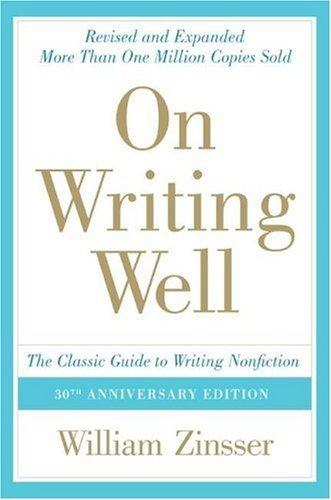
William Zinsser - On Writing Well
Zinsser's book, first published in the 70s, is part how-to, part autobiography and part travelogue. I say travelogue because he writes by telling us about the landmarks in 'good writing', the individuals who populate it and the methods that we should adopt to understand and better relate to good writing. His book verges on ethnography.
Echoing messages from Strunk & White; Booth, Colomb & Williams; McCloskey; Cook and several others, Zinsser endorses a writing style derived from accurate verbs and precise nouns. I believe this is the best advice he could give and he provides many motivations for his claims about style.
One Amazon reviewer felt let-down by Zinsser's continuous referral to his own writing processes, the reviewer wanted something even more 'how-to'. I found this criticism odd. Zinsser describes a method to write, contextualised in his work. He repeats a writer needs to write and edit, write and edit. He describes several ways to do this. He instructs the reader on methods for given subject matter and applies his methods by conjuring examples from his extensive knowledge of good writing, as well as his acquaintance with poor writing. Additionally, I have not read any writing guide that was 'independent' of its author, in fact if such a guide were written it would probably be hollow and vapid. Read the book and enjoy Zinsser's insight into writing well. I treasure this book already and I shall probably refer to it many times in the future.
On other topics
 Ryszard Kapuscinski - The Shadow of the Sun
This book is fantastic. Kapuscinski's essays on his experiences of living in, toiling through, and growing to adore Africa are phenomenal. I intend to put essays from this book on my reading lists for students when I teach courses about African Development one day.
When he writes, Kapuscinski captures what economists take reams to deliver. African development remains dependent on aid in many countries, many societies lack basic resources, and institutions built for extraction and exploitation obstruct their development.
Kapuscinski laments Africa's poor development and wishes that something could have happened to put more of African countries on paths to development. Kapuscinski's writing pulls you into the deep sadness he feels when he reflects on Africa, but the root of that sadness is a strong, powerful love that will draw him back to the continent, and, I hope, one day make him happy about the continent's achievements.

Anne Fadiman - At Large and At Small: Confessions of a Literary Hedonist
Prior to reading Fadiman's Ex Libris: Confessions of a Common Reader, I had not delved much into the personal essay genre. Reading Fadiman has changed that. My wife bought me Ex Libris for our first anniversary, subsequent to which and a couple of weeks after returning home, I looked up Fadiman online to see that At Large and At Small had recently been published. It is most definitely a 'literary gem', as one of the Amazon reviewers comments.
Fadiman deals with sensitive topics gracefully and wittily. In an interview, Fadiman commented that writing personal essays requires that you turn up the 'loudness of your voice'. If so, then somehow Fadiman has managed to select the perfect decibel equivalent at which her writings retain intimacy and factualness while they sustain humour and poignancy. Fadiman shows how she, and anyone really, can be simultaneously enamoured of an historic figure, while perturbed by their character, as evidenced by her commentary on Coleridge and Stefansson. Such personal paradoxes tie well into her essay on the culture wars where she laments the polarization of what makes literature worthwhile. She concludes that both literary value and moral lessons engage the reader and promote literature of all kinds and that the dichotomy is false. These and other ideas float tantalizingly on the surfaces of her essays, while anchored suitably by her research and by her breadth of reading.
I strongly recommend this book to anyone interested in Fadiman's previous collection Ex Libris, while telling them to be aware that they are in for a different literary journey: equally as good, but with a more varied landscape of subject matter.
 Lewis Buzbee - The Yellow-Lighted Bookshop
Having read Ex Libris and At Large and At Small
(above) I rated them on amazon.co.uk. This book appeared on my 'recommendations' list soon afterward. It was relatively inexpensive and well-reviewed, so I took the risk. I was very happy that I did so.
Buzbee's memoir and history detail his experience of book-selling in addition to describing the dynamics of selling books in the past, from Alexandrian scroll-sellers to modern day door-to-door Bible and encyclopedia salesmen (they seem always to be men, don't they?).
The book is easy to read, informative and well-written. It fills a space in my burgeoning collection of books about books. It is worth reading simply for the anecdotes that Buzbee recounts about the book industry. The research he put in to the history of books, book selling and publishing makes the book even more entertaining. I was happy Amazon's algorithms selected this book for me.
Next time
I am currently reading E.B. White's Essays of E.B.White, Paul Johnson's Creators and Marc Hauser's Moral Minds. I'll let you know how they go.

Monday, March 23, 2009
South African Scores an Own Goal for Democracy

Wow! Denying the Dalai Lama a visa, that's what I call self-righteous.
Or maybe it suppresses speech, shows South Africa kowtowing to Chinese interests and promotes illiberal politics inconsistent with the South African constitution.
I could be wrong though. it could be 'an independent, sovereign decision' as Ronnie Mamoepa says.
Hmm... methinks kitty represents my opinion well.

 William Easterly and Laura Freschi post on the Aid Watch blog about British Foreign Aid. Owen Barder calls them on several 'facts' that they got incorrect, indicating that their argument is thus deeply flawed (especially in the context of one of Easterly's own recent papers).
 Anyway, this highlights the value of blogging. People make a point, others, in the know and with access to the statistics, correct them quickly. Consequently, our intellectual capital can develop swiftly and improve in accuracy. What a valuable process!
HT: Chris Blattman

Saturday, February 21, 2009
Articles and Blog Posts
Willem Buiter - Capital Controls
New Scientist - Are We About to Eliminate AIDS?
Economist - Gesticulating Helps Children to Learn
Dan Hamermesh - An Economics Rap
Brad DeLong (in The Week) - End Times for Milton Friedman?
Seed - Adapting to a new economy (on evolutionary economics, I am a fan of the notion)
Axel Leijonhufvud - No Ordinary Recession
Vox - Volunteering and the State
Recent Essays I've Read
Emily Bernard - Teaching the 'N-word'
James McConkey - What Kind of father am I?
Nassim Taleb -The Fourth Quadrant: A Map of the Limits of Statistics
A fantastic resource for lectures online: Academic Earth.
A good poem: Samuel Taylor Coleridge - Christabel
Thursday, February 12, 2009
SA ranks 2nd Worldwide in budget openness
Duncan Green, at From Poverty to Power, comments on the recently released 'Open Budget Initiative'. What makes me happy is that SA is one of the top ranked for budget transparency protocols. That is fantastic.
Green's comment:
Only five countries of the 85 surveyed—France, New Zealand, South Africa, the United Kingdom, and the United States—make extensive information publicly available as required by generally accepted good public financial management practices.
This is really great for SA, especially in the current climate where you want to know what the government of the country in which you are investing is intending to do. Well done SA. Well done Trevor.
Saturday, January 31, 2009
I am currently reading Ryszard Kapscinki's collection of essays on living in and and reporting from Africa called The Shadow of the Sun. As many of you know, I am intrigued by parochialism and in-group and out-group preferences. Kapuscinski (2001, 188-89) captures the idea perfectly in his essay 'The Black Crystals of the Night,'
Our contemporary suspicion of and antipathy for the Other, the Stranger, goes back to the fear our tribal ancestors felt towards the Outsider, seeing him as the carrier of evil, the source of misfortune. Pain, fire, disease, drought, and hunger did not come from nowhere. Someone must have brought them, inflicted them, disseminated them. But who? Not my people, not those closest to me - they are good. Life is possible only among good people, and I am alive, after all. The guilty are therefore ther Others, the Strangers. That is why, seeking retribution for our injuries and setbacks, we quarrel with them, enter into conflicts, conduct wars. In a word, if unhappiness has befallen us, its source is not within us, but elsewhere, outside, beyond us and our community, far away, in Others.Does this not capture the notions well? Parochialism, war, altruism towards our in-group, distrust of the out-group all of these ideas are illustrated. Reading is such a pleasure.
Friday, January 30, 2009
As it was the festive season I took time off to ignore my google reader, get research done and then take a couple of days off with my wife over our anniversary (shock horror no internet access crazy!), I also went to Plett with my family before returning to Italy. As my South African sojourn ended there were flights and waits in airports (someone should write 'Doha: An Ode'). Consequently, I managed to read some books, mostly works of fiction, but there are a few non-fiction works sticking there hands up in the air awaiting a mention.
Fiction
After May's series, I read Evelyn Waugh's Brideshead Revisited which I had been intending to read for ages. My wife has a fantastic hard cover Everyman's library version. Although somewhat strange to get into at first (I don't seem to have much sympathy for Oxfordian life), I enjoyed the second half of the book greatly. The reflections on cultural degeneration, the issue of reconciling religion and death, of what it means to be married in pre-WWII England and what lovelessness within marriage entails was both disturbing and enlivening (enlivening because I sympathise, I suppose, with the problems with reconciling areligiosity and death). I recommend this book strongly.
Following this, I read Philip Roth's The Plot Against America. Wow! I love it. It is a phenomenal book. It is an alternative history that considers what might have happened in the US if, instead of FD Roosevelt winning the 1940 US Election, Charles Lindbergh had run as the Republican candidate and beaten FDR. It is told mainly from the perspective of 8-year-old Philip Roth. Roth has a total command of his conceptualisation of this alternative history and writes the details of it well, focusing on the experiences of a working class Jewish family in Newark, New Jersey. Although potentially difficult for some because of its weighty factual nature in certain sections, the writing pulls you through, and brings you to a better understanding of the United States. This is high quality social commentary from Roth.
E.M. Forster's Maurice was next up on my shelf. Amy had been recommending this to me for ages, we had previously found a copy in that fantastic bookshop on Kloof Street (the name of which I forget), Book Lover's Paradise I think. It had sat on the shelf, unread, while I was here in Italy (Amy had read it previously for a course at uni). The book is a beautifully written, and fantastically witty, depiction of the adolescent and young adult life of Maurice, a young man from an upper class, but not noble, British family. Maurice is homosexual. Forster protrays the struggles that Maurice goes through with forcible and graceful language, portraying both Maurice's limitations to his partners, his fall, his classism (which Maurice fails to realise is as bad as homophobia) and, finally, a sexual and mental awakening to the ways in which his homosexuality will affect his life. The book is highly meaningful as one of the first pieces of genuine 21st century 'gay' literature, as Forster completed the work in 1914 but it was only published posthumously. Forster's reflections on the laws in the UK, which he wrote as part of an afterword during the 1960s, also shows how worried and anxious he was about the state of the law in the UK and how he felt that homosexuality would never be granted the status that it now has. This book is beautiful, easy to read and the timbre of Forster's writing voice is well worth listening to.
Finally, completing the fiction, I bought Terry Brooks's The Gypsy Morph in the Exclusive Books of Cape Town International Airport and finished it by the time I arrived in London (having sat in Doha for five hours twiddling my eyeballs). So yes, I had time to finish that. This book was the finale in Brooks's 'The Genesis of Shannara' trilogy. I am an old fantasy and sci-fi hack and I took pleasure in reading this book. This is good journeyman fantasy, decent battles, magic, elves, etc with a final resolution that ties together the world of a post-apocalyptic 'Earth' and that of Shannara. It was like a decent action movie: enough battles and thrilling events to keep the story moving, tied in with a worthwhile, if somewhat simple, plot. Perfect for hours in Doha waiting for my Qatar airways flight.
Non-fiction
As promised previously, a comment on Malcolm Gladwell's Outliers warrants some space. There has been a fair amount of commentary on this book (which I don't feel like linking to, sorry). Gladwell brings together a host of case studies and various research to bring together his ideas about success. He argues that success is basically composed of luck and hard work. However, you also have to be lucky enough to realise that hard work is necessary for success, so that is also part of the luck component. Underpinning both of these, though, are institutional structures (my terminology), such as the cutoff dates at school, the transaction costs of changing from one school to another (low during the 50s and 60s, high now), the mobility between areas, and the recognition given to one group rather than another (i.e. to what extent race disadvantages you because of the institutional structures reinforcing your position). The book is interesting, but I didn't get anything substantially 'new' from it except for some case studies. The studies link the argument together well, but they don't really do anything to tell us about how to change the system, or how to change people's thinking about success, except to show them the evidence against them. Historically, this has not worked: many libertarians still seem to believe in absolute freedom of choice and that institutional constraints don't exist. The book is worthwhile because it brings academic debates to hoi polloi and will hopefully strengthen the understanding that individuals are constrained by history and luck and that 'ability' doesn't always just shine on through.
Next time
Graham Greene's The Quiet American, Ryszard Kapuscinski's The Shadow of the Sun and hopefully Roberto Bolano's 2666 once my order from Amazon arrives.
